


 Technology
 PUBLISHED




When you think “birds-of-paradise”, your mind may jump to the bright, rainbow plumage of species like Diphyllodes magnificus or Paradisornis rudolphi. But equally present in the natural world is the exact opposite – a black so deep that it reflects less than 0.5 percent of the light that touches it – and now, scientists know how to make it for ourselves.
“Wildlife often uses a combination of colors in their skin, scales, and feathers to both attract mates and avoid predators,” begins a new paper from researchers at Cornell University’s Department of Human Centered Design – and “the various nano/microstructures that produce ultrablack have been studied and replicated synthetically.”
But as smart as we humans are, there are some things that nature really has us beat on – and creating this “ultrablack”, effective and on the cheap, is one of them. Our own attempts, the paper notes, still “use highly advanced and costly techniques, toxic substances, and lack the flexibility and biocompatibility that are often desired in real-world textile applications.”
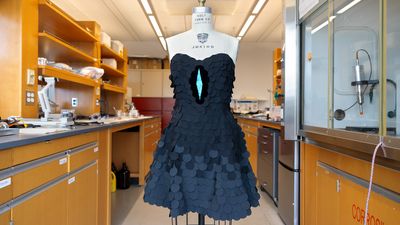
That’s a shame, too, because the color has a wide range of potential uses. Since it absorbs more than 99 percent of the light that hits it, it has obvious implications for solar energy conversion, for example; it can fine-tune cameras and telescopes by cutting out stray light that pollute the images. And of course, there are the fashion implications: the team has already crafted a pretty fancy dress out of the material, with an iridescent blue panel in the center that nods to the magnificent riflebird whose coloring inspired it.
So, how does one go about replicating the look of a magnificent bird? Well, step one is to figure out how they do it in the first place – and the key is simple: melanin.
“[M]elanin is what these creatures have,” explained Larissa Shepherd, assistant professor in the Department of Human Centered Design, in a statement this week. “And the riflebird has these really interesting hierarchical structures, the barbules, along with the melanin.”
These barbules – the tiny, thread-like filaments that branch out off the main barb of a feather – are tightly bunched together and covered in microscopic grooves and cavities. That, combined with the melanin, allows the bird to essentially absorb almost all the light – “so we wanted to combine those aspects in a textile,” Shepherd said.
Rather than real melanin, the team opted for polydopamine – a synthetic melanin created by exposing regular dopamine from mussel goop (scientific term) to alkaline conditions and combining it with a compound known as catechol. They used the pigment to dye merino wool knit fabric, turning it an inky black, then made use of a technique known as plasma etching to create nanoscale scratches on the surface, creating spiky “fibrils” that replicate the tiny structures in the birds’ barbules.
“The light basically bounces back and forth between the fibrils, instead of reflecting back out,” explained Hansadi Jayamaha, a researcher in the university’s Responsive Apparel Design (RAD) Lab. “[T]hat’s what creates the ultrablack effect.”
And ultra it most definitely is. Analysis of the final fabric revealed an average reflectance of just 0.13 percent, “represent[ing] the darkest fabrics currently reported,” the paper boasts. And it avoids the issues many other super-dark blacks show when viewed from anything other than straight-on: “it exhibits wide-angle ultrablack performance, maintaining a symmetric (angle-independent) optical response across a 120° angular span,” the authors write.
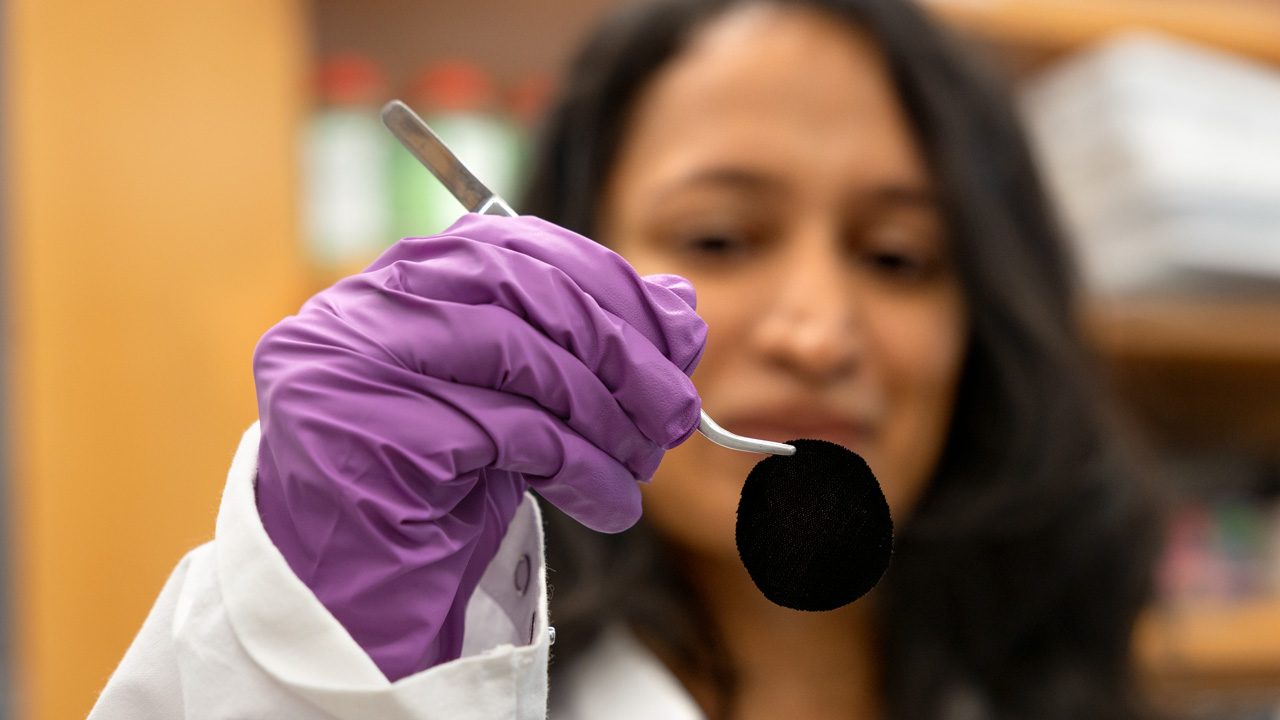
But more than that, it seems that this fabric might actually just be… nice? “Unlike commercially available ultrablack fabrics, the ultrablack wool developed in this study remains breathable and conformable,” the paper notes. It’s wash-fast, light-fast, and durable, the authors write, and both flexible and wearable.
Best of all: if all goes to plan, it shouldn’t be too long before this technique is commercially available. The team has applied for provisional patent protection on the technology – so watch this space.
The study is published in the journal Nature Communications.




 1
1