Nature
 PUBLISHED


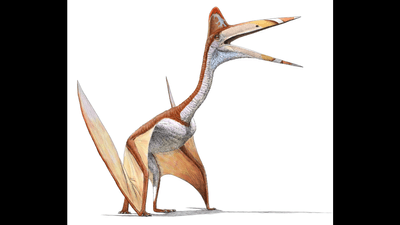


Call in the forensic experts, for a crime has been committed (albeit, 76 million years ago). That’s according to an “exceptionally uncommon” fossil of a young pterosaur that shows it was bitten by some kind of ancient crocodilian way back in the Cretaceous period.
There’s nothing we can do for the juvenile Azhdarchid pterosaur (Cryodrakon boreas), whose estimated wingspan of 2 meters (6.6 feet) indicates it was struck down well before its prime; this species could grow to the height of a giraffe with a wingspan five times that by adulthood. We can, however, celebrate its sacrifice as it provides a rare and valuable snapshot of predator-prey dynamics in what’s now known as Canada over 70 million years ago.
When we realised there was a bite mark on it, it was like icing on the cake.
Dr Caleb Brown
The fossil neckbone was retrieved in Alberta and came complete with a 4-millimeter (0.2 inches) puncture that the team confirmed wasn’t an injury sustained during its excavation, but a bonified bite mark (pun very much intended). We don’t know if the bite was received before or after death, but it tells us that crocodilians were either preying on or scavenging juvenile pterosaurs in this part of the world, at this time in Earth’s history.

The main candidate for the animal that made the bite is Leidyosuchus canadensis.
Dr Brian Pickles
"We were quite excited with the initial discovery of a pterosaur bone as it was the first evidence of this group of animals from this bonebed we had been working," study lead author Dr Caleb Brown from the Royal Tyrrell Museum of Palaeontology told IFLScience. "When we realized there was a bite mark preserved on it, it was like icing on the cake."
"What I find most remarkable is that a single partial fossil bone can still provide evidence of what happened between two individual animals from 76 million years ago. It is not always about the most complete or beautiful fossil; even partial isolated fossils can tell a story."

But who’s behind it all? I hear you cry. What crocodilian could be so bloodthirsty as to snack on a baby? Well, first of all, that's all of them, but according to study co-author Dr Brian Pickles of the University Of Reading, there is one suspect that stands out above the rest.
“The main candidate for the animal that made the bite is Leidyosuchus canadensis, which is a basal member of the Alligatoroidae (i.e. it comes from a lineage that is ancestral to modern alligators and caiman),” he told IFLScience. “These were medium-sized crocodilians, probably a similar size to modern alligators (approx. 3 to 3.5 m as adults).”

A remarkable story, then, to have been captured in the neck bone of a pterosaur, but the discovery becomes even more incredible in the context of how delicate these fossils are.
“These are large reptiles with at least some capacity for flight, so they need to be as light as possible,” explained Pickles. “The solution to that is to reduce the amount of bone to a minimum. With this vertebra, we can see that the bone thickness is less than 1 mm (we measured it as ~0.6 mm), so we would expect it to be quite delicate. When you consider that crocodilians are evolved to produce significant bite forces it is surprising to find an example like this where we can see the puncture mark from the tooth but much of the rest of the vertebra is intact.”
Suspect named, shamed, and evidence added to the fossil Hall of Fame? That sounds like justice served to me.
The study is published in the Journal Of Paleontology.