Nature
 PUBLISHED


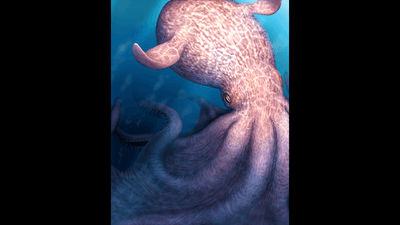


As if the seas of the late Cretaceous era didn’t already have enough enormous predators, new research indicates they also contained giant octopuses that make the ship-sinking kraken of Norse mythology believable. Fossils indicate these beasts grew up to 19 meters (63 feet) long. At that size, they would have contested the bounty of the seas with plesiosaurs and mosasaurs, and possibly even eaten these giant reptiles.
Most ecosystems support only one or two species of large apex predator. On land, this was true in the Cretaceous as well – the famous mighty meat-eaters were usually separated by oceans or millions of years from each other. The oceans were a different matter, particularly the eastern Atlantic, which shortly before the asteroid hit hosted around a dozen terrifying giants.
We don’t understand how this balance was maintained, although undoubtedly the seas of the era were unusually productive. Nevertheless, it seems the list of creatures battling for the status of apex predator was even longer than we thought. Besides all the reptiles and sharks of the day, invertebrates grew bigger than any of them, although not necessarily in the same locations. Shark versus octopus match-ups would have needed to be multi-round tournaments.
This is the conclusion of a study of the jaws of ancient octopus relatives.
Lacking bones, squid and octopuses seldom fossilize well. However, their jaws are tougher, and more likely to be preserved. Dr Shin Ikegami and co-authors examined 27 large fossil octopus jaws, and identified them as belonging to two species, Nanaimoteuthis jeletzkyi and N. haggarti. Extrapolating from jaw size, the authors think N. haggarti ranged from 7 to 19 meters (23-63 feet long), while even its smaller cousin was much larger than any modern octopus.
This makes N. haggarti likely the largest invertebrate ever identified, probably exceeding the largest reptiles of the era, which included 17-meter (56-foot) mosasaurs and 12-meter (39-foot) plesiosaurs. Modern giant squid grow to 12 meters long, larger than any other known invertebrate fossils, but quite modest by comparison.
Although the mantle and tentacles fossilized less often than the jaws, the authors found enough examples to conclude Nanaimoteuthis had a relatively elongated body, similar to many of their modern relatives, but unlike the deep sea umbrella octopuses. The mantles alone of the largest specimens grew to 4.4 meters (14.5 feet) long.
The better-preserved jaws show extensive signs of wear. Apparently there were no jaw sharpeners in the Cretaceous oceans and older individuals’ jaws were much more blunted than the sharp cutting edges of the young. That indicates their diet included hard shells and big bones. The famous intelligence of modern octopuses can be seen in the way the jaws were more worn on one side than the other, indicating a problem-solving approach to getting at food protected by a shell, rather than charging straight in.
As the authors note, “Top predators drive changes in ecosystem structure,” so the presence of invertebrates in a position more recently occupied by vertebrates could have influenced the entire food web. Perhaps our vertebrate bias has led us to underestimate the status of cephalopods as top of the food chain in one of the most competitive eras.
The discoveries include the oldest octopuses ever found, by 5 million years. However, since new animal families usually evolve small and grow later, it is likely there are predecessors we are still to find.
The authors note that the larger members of the cephalopod class, of which octopuses are part, appear to have evolved in parallel to the largest marine vertebrate predators. Both started out with heavy scales or shells to protect themselves from their own kind or others of similar size, but sacrificed that with time. “[B]oth groups increased swimming performance, body size, and intelligence at the expense of defensive hard parts,” they write. “Long after the rise of vertebrate top predators, octopuses evolved body plans capable of rivaling them”.
Speed and brains beats plenty of armor, it seems. There has to be a lesson there for someone.
The study is published in Science.