Nature
 PUBLISHED
 1
1


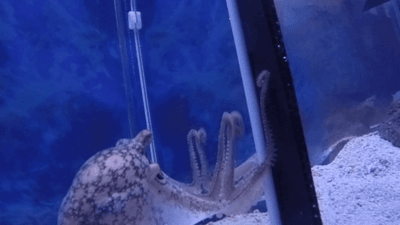


New research that taught octopuses how to use a mirror has demonstrated they exhibit a kind of spatial cognition that had previously only been documented in vertebrates like mammals and birds. In pursuit of a reward, the octopuses were able to orientate their attacks using information from a mirror that revealed where behind them a crab was lurking. That’s right, they gave octopuses rear-view mirrors.
It marks the first study of its kind to prove that invertebrates can use mirrors to navigate their environment and find prey. Getting there involved the help of three California two-spot octopuses (Octopus bimaculoides) working with scientists at the Octopus Lab at Dartmouth University, New Hampshire.
Octopuses aren’t natural born scientists, so, like us, they needed a bit of time to acclimate to the lab environment. Then it was time to introduce them to the concept of a mirror.
“We started to acquaint them with a mirror by putting them in an aquarium in which a mirror took up half the width of the midline,” lead author Marie-Luise Kieseler told IFLScience. “This way the octos not only get used to the reflective front of the mirror but also see it from the back. The intention was for them to learn that the mirror is not an extension of space but an object and to also give them the option to avoid the reflective surface if they wished.”
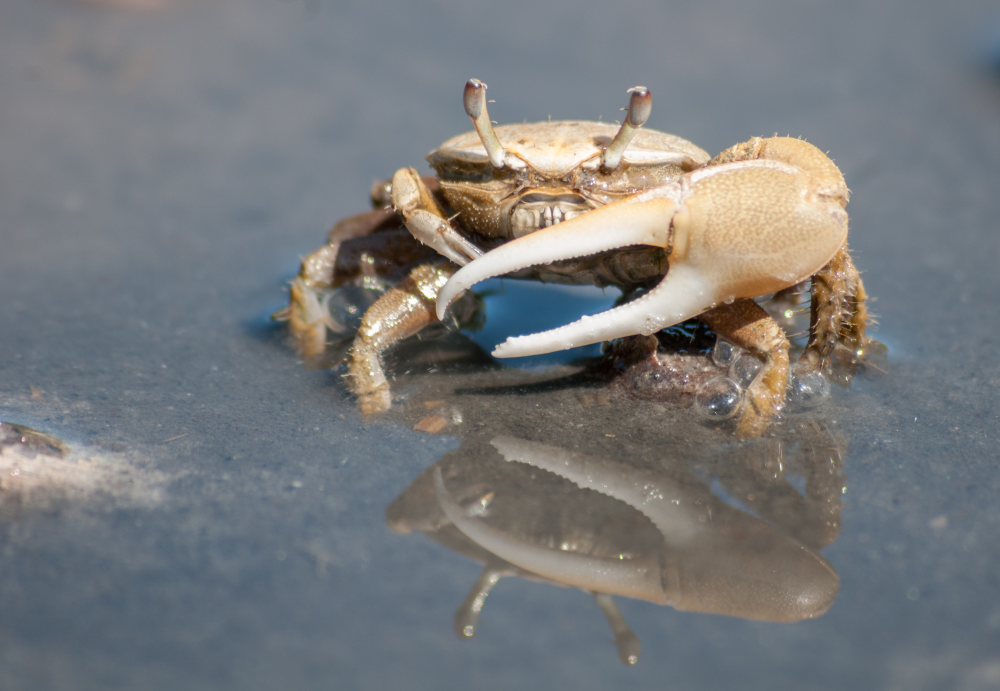
After a few sessions they had it figured out, so the next step was to teach them how to understand the spatial relations between what they could see in the mirror and where that object actually was. This was achieved using crab in a glass jar that was positioned at a 90-degree angle to the mirror. In the first trial, the octopuses went for the mirror, but once at the glass, they had a direct line of sight to the actual crab.
The octopuses eventually got to grips with that, too. So, the final step was to prove that they really were relying on the reflection in the mirror alone to figure out where they needed to go and not, say, the smell of live prey.
“To do that, we set up a new layout in which the octopus would have to do a 180-degree turn either to the left or right side to obtain a reward,” said Kieseler. “And also used a projected, virtual crab instead of a live crab in the tank.”
Sure enough, the octopuses successfully went after the virtual crab in 73 percent of trials. Using mirrors to understand the environment and then use that information to seek out prey isn’t something that’s been documented in invertebrates before. It’s further evidence of the remarkable cognitive skill octopuses are already known to have, and an indicator as to just how far back this kind of spatial awareness goes.
“Octopuses diverged from us evolutionarily more than 500 million years ago (for comparison, the T. rex was ~67 million years ago), and their bodies and nervous systems are very different from ours,” said Kieseler. “Yet, they still developed the capacity for spatial reasoning that we see in much closer relatives like primates and other vertebrates.”
“Many people know octopuses are smart, but when we started this study, we genuinely didn't know if they had the cognitive capabilities for something this advanced. Seeing an animal so different from us clearly figure out how a mirror reflection relates to the space surrounding them was an extraordinary experience.”
Extraordinary indeed, but the octopuses sure made them work for it. Octopuses aren’t easily motivated to take part in research, and timing of a food reward was critical to making sure they cooperated with the experimental design. They were also only motivated by a large reward (a whole fiddler crab), so were close to too-full-to-function after a single trial per day.
Octopuses also have a lifespan of 1.5 to 2 years, and since the trials began with adults it was a bit of a race against time to get them suitably trained and with enough daily trials under their belt before the end. Then, there’s the fact that they’re really quite stubborn.
“Our octopuses were quite opinionated animals who would sometimes just refuse to do the experiment and go to sleep or sit on the mirror, or they would work only with certain people, and each octopus had different preferences,” said Kieseler. “This meant we had to match the individual animal to a study carried out by researchers they preferred, adding another layer of coordination to an already complex study.”
Complex indeed, but the combined efforts of these octos and scientists has revealed another cool magic trick we have in common with Earth’s closest answer to aliens.
The study is published in the journal Current Biology.