Nature
 PUBLISHED


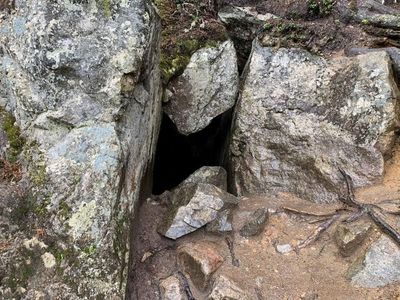


There is a cave in Finland that has long been associated with the supernatural. The folklore surrounding this site is so strong that, even today, practitioners of modern shamanism hold drumming sessions there. But what makes this place so spiritually special? Well, a new study has suggested an answer, which although mundane, is still pretty cool.
The crevice cave, known as Pirunkirkko (the Devil’s Church in English), is located in the Koli mountain range in Eastern Finland and is a mythical place for Finns. For well over 100 years, the surrounding forests and landscapes of the Koli National Park have attracted visitors and artists who want to soak up the spectacular views. But the cave itself has a longer history, and one steeped in mystery.
It is said that sages, known as tietäjä, velho, or noita, in Finnish, would gather in the cave and use sound to communicate with the spirit world. Much like shamans, these individuals would undertake their communion while in ecstatic states of mind, raging, shouting, jumping, kicking, and fighting with or to simply intimidate unseen forces. They would also sing, incant, and make other noises (like shooting guns) as part of their rituals.
Sound, it seems, may have been a crucial aspect of these practices, which led Riitta Rainio, a researcher of archaeology at the University of Helsinki, and Elina Hytönen-Ng, a researcher of cultural studies at the University of Eastern Finland, to investigate the acoustics of the Devil’s Church.
They wanted to see if the acoustic properties could help explain the beliefs associated with the space, and perhaps why it was chosen as a suitable site for these preternatural gatherings that relied on sound.
The researchers found that the Devil’s Church is home to a distinct resonance phenomenon that amplifies and lengthens sound at specific frequencies. This, they believe, may have influenced the beliefs and experiences surrounding the cave.
While reviewing archival evidence, they found that one sage operating in the area, a man known as Kinolainen, or sometimes Tossavainen, used the cave for his spiritual practices.
"According to folklore, Kinolainen would take his patients to the 'church' to talk with the Devil about the causes and cures of their ailments. This kind of a healing ritual often included loud yelling, stomping, shooting and banging," Rainio explained in a statement.
Hytönen-Ng also interviewed and observed a modern shamanic practitioner who uses the cave for their rituals. According to their account, the cave has special energy that allows them to connect to the surrounding nature and to “one’s roots”.
"The practitioner told in the interview that drumming sessions especially at the back of the cave have opened up 'new horizons'."
Acoustic measurements taken in the back of the cave, which is structured like a corridor with smooth walls, show a strong resonance phenomenon. It is caused by a standing wave between the parallel walls, which generates a tone at the natural frequency of the cave – 231 Hz. This tone remains audible for around a second after sharp impulses, like clapping or drumming.
Tones vocalized in the space near the 231 Hz frequency are amplified and lengthened.
"We recorded the shamanic practitioner and found that they repeatedly vocalised tones at 231 Hz, which were then amplified by the cave at its natural frequency."
An exceptional space with rare properties
According to the researchers, resonance is a common phenomenon in built environments, but rarely occurs in nature. The key for the Devil’s Church is its smooth parallel walls which has made it capable of producing this rare resonance.
Similar resonances have been observed in other locations too, such as the Palaeolithic caves of France and Spain, which occur near known cave paintings.
Rainio and Hytönen-Ng hypothesize that the Devil’s Church resonance would have been a constant, if subtle, companion to rituals practiced there through the centuries.
"Where a researcher of acoustics hears [a] resonance, people of the past may have sensed the presence of a spirit, and a shamanic practitioner may feel the presence of an exceptional energy, each according to their background."
The study is a powerful demonstration of how resonance can be used to promote communication between a physical space or the natural environment.
The study is published in Open Archaeology.

 1
1