Nature
 PUBLISHED


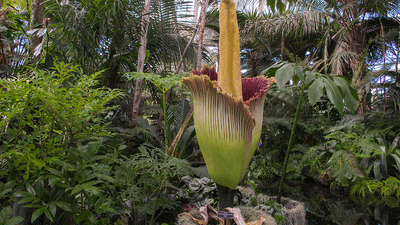


A titan arum (Amorphophallus titanum) specimen at Kew Gardens, London, England, has bloomed for the first time in years, releasing its trademark almighty stench.
The plant was first described in 1878 by Italian botanist Odoardo Beccari, who found it in Sumatra, Indonesia. Beccari sent seeds to several botanical gardens, including Kew, where these strange plants of the Araceae family have been cultivated and studied for over a century.
The plant flowers rarely and irregularly, but roughly speaking puts on the display around every 7-9 years according to the Eden Project. When it does, it is spectacular to the eyes and painful on the nose, and then after a few short days, it is over.
"The inflorescence has gigantic dimensions. It consists of a spathe which forms a tube at its base where tiny female flowers are arranged below the small male flowers. The spathe opens during the afternoon and during the first night the female flowers bloom," a paper on their cultivation explains.
"A strong smell of carrion is released at short intervals but only for a short period of time during the first night, when the plant is in its female stage. Towards the end of the first night the spathe may close a little or more. During the second night, the male flowers bloom producing masses of yellow pollen. On the second day the inflorescence closes completely and may stay upright for about another day. Then the spadix collapses."
The stench from the flower has earned them the nickname the "corpse flower" or "corpse plant".
"The most common odors describe it as smelling like a rotting animal, a dead mouse, foul, and sulfur-like during flowering," a paper on the compounds emitted by the flower explains. "Though produced simultaneously, the individual volatile molecules emitted during female flowering include: dimethyl disulfide (garlic-like odor), dimethyl trisulfide (foul odor), methyl thioacetate (sulfurous odor), and isovaleric acid (cheesy, sweaty odor)."
The smell – one of the strongest given off by plants in the world – is useful to the plant in the wild, helping it to attract pollinators.
"Corpse flowers are also able to warm up to 98 degrees Fahrenheit (36.7 Celsius) to further fool the insects," Tim Pollak, outdoor floriculturist at the Chicago Botanic Garden, told Live Science. "The insects think the flower may be food, fly inside, realize there is nothing to eat, and fly off with pollen on their legs. This process ensures the ongoing pollination of the species. Once the flower has bloomed and pollination is complete, the flower collapses."
The flower at Kew is currently open, but will not be open for long – it typically only blooms for a day or two.