Nature
 PUBLISHED


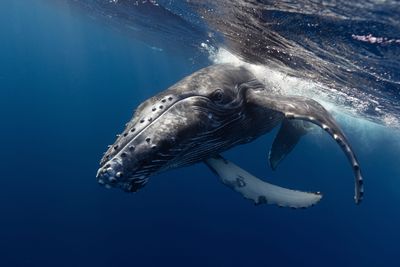


Whales have developed all sorts of ingenious ways to catch the monumental amount of food they need to keep going.
Orcas, for example, will synchronize their swimming to create bow waves to literally wash seals off ice floes (and sometimes will make sunfish explode, just for fun). Eden’s whales sometimes simply open their mouths at the surface and wait for fish to swim in.
Humpback whales have also been observed performing all sorts of feeding behaviors. One of their most impressive involves up to 33 whales swimming in a circular formation while breathing out to produce a bubble net that traps schooling fish, which are then gulped up near the surface.
But it was while studying a group of humpbacks living in the Gulf of Maine off the coast of Massachusetts that researchers noticed the whales making a distinctive “double-pulse” call while swimming along the bottom at night and in low-light conditions.
Curiosity piqued, they wondered if this indicated that the animals were coordinating their behavior.
To solve the mystery, the team used tags to record the whales' movement, audio, and even video. What they found blew them away.
The velociraptors of the sea
In a scene not dissimilar to the velociraptors of Jurassic Park, one whale will swim along the sandy bottom, disturbing sand lance fish that are buried in the sediment. In the meantime, two other whales will swim in out of the gloom at 11 o’clock and 1 o’clock angles, opening their mouths and rolling onto their side in unison when within just a few meters of the first whale and gobbling up the fleeing fish.
As Robert Muldoon might say, clever girls.
As with the fictional movie dinosaurs, scientists think that this behavior is fully coordinated and therefore helps to shed light on the intelligence of these whales.
“The goal of the present work was to investigate the level of cooperative hunting in benthic-feeding humpback whales and present evidence that the behavior is coordinated and satisfies many characteristics of collaboration, the most cognitively complex level of cooperative hunting,” the authors write.
Out of 110 benthic hunting events, meaning the whales were feeding along the seafloor, 79 percent involved the whales working together, either in a group of three or four.
According to the researchers, the fact that these events often involved the same individual whales shows that this was not simply aggregation but cooperation.
Innovating whales
Whether or not the same whales were frequently working together, or even if they are related, has been difficult to discern due to the poor light conditions. This means that while they know who the initiating whale is, as it was tagged, the team is less certain about the identities of the whales coming in from the sides.
They suspect that the behavior is being driven by a number of different factors. For example, low prey availability might be driving the whales to innovate, and their high intelligence means that by working together they can catch more food.
Unfortunately, it might also be putting them at risk.
“While highly advantageous as a foraging mechanism, benthic-hunting places humpbacks at increased risk of entanglement in bottom set fishing gears, such as trap pots and gill nets, which are ubiquitous worldwide,” the authors write.
They hope that by better understanding these unique behaviors, we can better protect these amazing animals.
The study is published in the journal Behavioral Ecology and Sociobiology.