Nature
 PUBLISHED
 16
16


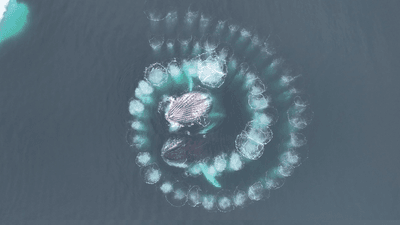


Extraordinary drone footage filmed in Antarctica shows two humpback whales (Megaptera novaeangliae) creating the perfect bubble net and a Fibonacci spiral to boot.
Polar photographer Piet van den Bemd captured the footage of the whales working together. The bubble-net feeding technique involves the whales diving below their prey, then using bubbles created from their blowholes to trap the fish closer to the surface of the water. According to the National Marine Sanctuary, these whales are known as “gulp feeders", meaning they will go up to the surface with their mouths open and gulp down everything in their way – including the fish they have trapped with their bubbles.
The behavior is highly complex, involving timing, coordination, communication, and teamwork, and highlights what intelligent animals the whales are. Previous work has found that the behavior is learned, meaning not all humpback whale populations feed using this technique.
When showcasing this behavior in van den Bemd's footage, the whale's bubble net pattern matched that of a perfect Fibonacci spiral, also known as a golden spiral. In geometry, it is a spiral that grows by a factor of φ, known as the golden ratio, for every quarter turn the spiral makes. It appears to be a common occurrence in nature, featuring in pinecones and many fruits and vegetables, although it has also stumped scientists looking for it in the fossil record.
“The Fibonacci spiral shape executed perfectly made it incredible,” van den Bemd told Storyful, adding that it was a moment he’d “absolutely never forget.”