Technology
 PUBLISHED
 6
6


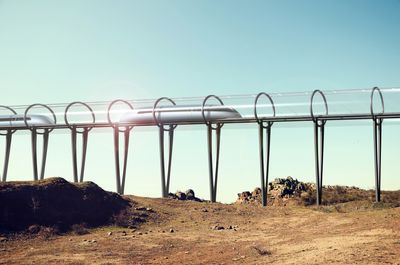


China has carried out another successful test of their answer to Hyperloop, an ultra-high-speed maglev train that they plan to travel at speeds of 1,000 kilometers (621 miles) per hour. While it hasn't yet achieved this blazing speed – despite some misleading news reports – the latest tests suggest their pipe dream is going to plan.
The maglev train recently completed a test at a 2-kilometer-long (1.2-mile) pipeline with a low-vacuum environment in the Shanxi province of North China, according to a report by Chinese state media network Xinhua.
The demonstration reportedly showed the advanced transport system can perform “controlled navigation, stable suspension, and safe stopping.”
Development of the trailblazing transport system is being led by the China Aerospace Science and Industry Corporation, the Chinese state-owned enterprise behind the country’s spacecraft, launch vehicles, and missile systems.
Just like other iterations of maglev technology, their ultra-high-speed train system uses magnetic levitation to eliminate friction between the train and tracks, allowing for smoother and faster travel. The low-vacuum tubes also reduce air resistance, allowing trains to travel faster with less energy by minimizing drag.
Some Western media outlets have reported that China’s maglev transportation system has recently achieved speeds of 1,000 kilometers (621 miles) per hour in the latest demo, but this doesn’t appear to be the case. The report did not explicitly mention the speed it achieved, instead stating that the transportation technology is still "aiming to achieve" these ultra-high speeds.
Nevertheless, previous tests have shown the vehicle is capable of whipping up speeds of over 623 kilometers (387 miles) per hour at a full-scale test track.
Off the back of the recent test in China, companies in the US are hoping the news could kickstart some renewed interest (and no doubt investment) in Hyperloop technology elsewhere in the world.
"China's recent success with their T-Flight high-speed maglev system is a clear demonstration that hyperloop technology is not a distant dream, but a rapidly emerging reality. This breakthrough underscores the immense potential of hyperloop as the future of transportation, offering unparalleled speed, efficiency, and sustainability,” Andrés de León, CEO of US-based company HyperloopTT, said in a statement sent to IFLScience.
“The technology is proven, the benefits are clear, and the time for action is now. With the right combination of political will and private sector engagement, we can accelerate the development and implementation of hyperloop systems to ensure that the US remains competitive in building the most efficient high-speed transportation solution of our time,” he added.
Correction (14/08/24): The title of this article was updated to correct a typo - it previously read "100 kilometers" instead of "1,000 kilometers".