Technology
 PUBLISHED
 39
39


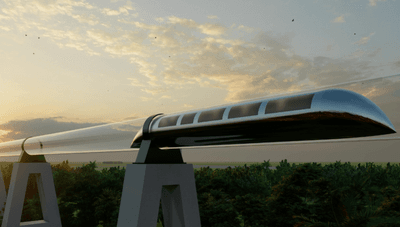


China’s answer to the Hyperloop, an ultra-high-speed maglev train, has recently broken its own speed record by achieving speeds over 623 kilometers (387 miles) per hour at a full-scale test track.
The project is being run by the China Aerospace Science and Industry Corporation (CASIC), a state-owned aerospace company that makes everything from rockets and missiles to satellites and spacecraft.
In 2023, the train reached a record-breaking speed of 623 kilometers (387 miles) per hour in a test run under non-vacuum conditions. As reported by the South China Morning Post, CASIC claims that new tests have surpassed the previous record. The exact speed is reportedly remaining classified for now.
What's more, the test was performed in a low-vacuum tube, proving the maglev technology works as intended. The advanced train system smashed the speed record at a full-scale 2-kilometer (1.2-mile) test line in the city of Datong in Shanxi province, northern China.
The vehicle relies on maglev technology, which uses magnetism to propel the train forward, as well as levitate it above the tracks thereby reducing friction. To further boost its speed, the train travels through a specially designed low-vacuum tube that reduces air resistance.
The technology is advancing at a mindblowing speed. In October 2022, CASIC boasted a train test run that reached speeds of 130 kilometers (81 miles) per hour. The latest attempt is well over four times that speed.
More could still be yet to come too. CASIC has previously expressed interest in shuttling trains at a maximum speed of 1,000 kilometers (620 miles) per hour and they’re looking to create technologies that could go as fast as 4,000 kilometers (2,485 miles) per hour.
Before the CASIC's record, the fastest hyperloop speed was 463 kilometers (288 miles) per hour, achieved by a team of engineers at the Technical University of Munich in July 2019.
As of 2018, there were only six maglev train systems in operation across the world: three in China, two in South Korea, and one in Japan. All of these trains travel in the open air, as opposed to ones that use low-pressure tunnels known as hyperloops.
While maglev trains can travel at impressively fast speeds, they are extremely expensive. They also use vast amounts of energy and require their own dedicated infrastructure that's tricky to integrate into existing transportation systems.
Meanwhile, outside of China, Hyperloop One, the company behind a futuristic transportation system once touted by Elon Musk, shut down late last year.
The dream of hyperloop technology is clearly not dead yet, though. There has been talk of a commercial hyperloop system in Italy, connecting Venice-Mestre and Padua in less than 15 minutes. Bear in mind, however, that the train journey time between Mestre and Padova currently takes around 14 minutes.