Technology
 PUBLISHED
 1
1


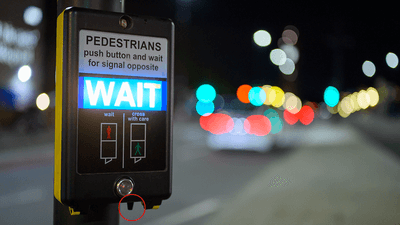


If you have a child or were one (covering all possibilities there), you are likely familiar with the simple joys of being the person to press the button at pedestrian crossings, and having the cars stop shortly afterwards.
Play around with them for enough time, perhaps whilst shoving away a sibling who is also trying to press the magic "make cars stop button", and you may have noticed an unusual feature on the underside of the casing. Have a root around down there, and you may find on a lot of them that there is an odd little cone, with little ridges all over it, which springs into action and begins rotating around the same time the lights turn red.
These aren't commonly known about, but they are certainly life-saving and life-enabling little cones.
The world as it is is pretty well set up for people with good eyesight. In recent times (humans have a long history) more of an effort has been made to accommodate people who are blind, or have other vision impairments. For example, in train stations you may have noticed "tactile pavements", often painted a bright yellow, placed near a platform's edge.
"Blind users can utilise the touch and tactile cues that the paving provides underfoot and/or using a long cane, to navigate around an environment safely and effectively," UK railway company Network Rail explains, adding that only around 7 percent of blind and partially sighted people have no vision at all.
"Partially sighted users can also utilise the tactile cues (underfoot and/or by long cane), but the tactile paving system may also provide additional visually contrasting cues to aid both orientation and mobility."
These aren't just an added bonus, or a way to make train stations more inclusive, but a way to keep people alive. The Royal National Institute of Blind People (RNIB), pushing for tactile paving to be placed at all train stations in the UK, highlights the case of Cleveland Gervais, a man with sight loss who was hit by a train and lost his life after falling from a platform with no such tactile edge. Simple changes like this can save lives.
The idea is similar with the devices on pedestrian crossings, known as rotating cone tactile devices. They are there to indicate that the traffic lights are now red, in a way which can be sensed by people with little or no sight. A visually impaired person, after fighting off a sibling who also wants to press the button, can place their hand on the cone and wait for it to spin, to show that it may be now safe to cross.
.jpg "UK pelican crossing box shown from underneath with a small rotating cone tactile device protruding from it")
"An important point to make is that I wait for the cone to rotate but combine the information that it gives me with listening to the traffic on the road in front of me. You can hear whether they're changing gear or slowing down," Hugh Huddy, a blind man who works at the charity Vision 2020, explained to the BBC.
"The cone isn't telling you it's safe to cross, it's telling you the light is on. For instance, cyclists like whizzing through crossings sometimes, even though they shouldn't."
Though not mandatory, in the UK at least, the devices are reasonably popular, with the company who manufactures them – Radix – telling the BBC that they have sold around 10,000 units a year since the mid-1990s.
Unless you're especially handsy with crosswalks, you probably haven't noticed these devices before, but if you haven't got vision loss you aren't really meant to.
But for the people who do need them, these little features provide an easy and tactile way to navigate the roads better, making the world just a little more accommodating for the millions of people around the world with vision impairments.