Technology
 PUBLISHED
 4
4



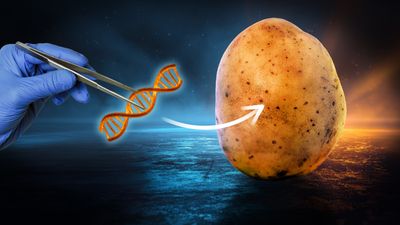


Each year, hundreds of thousands of people die of famine across the planet, and with the effects of climate change spiraling, that number is pretty much guaranteed to climb.
But in 2021, a team of intercontinental researchers had a wacky idea for how to mitigate it all.
Plants, they realized, would be key. The world needs crops to feed its ever-growing population; it needs trees and grasses to capture and absorb carbon, to reduce temperatures and pollution, enrich the soil, and more.
“We rely on plants for many, many things,” said Chuan He, a professor of chemistry at the University of Chicago who co-led the project, in a press release at the time. “Everything from wood, food, and medicine, to flowers and oil.”
Of course, there’s a problem: we already produce all those plants and the issues are still rather obviously here. What we need is a way to boost the amount we can grow. We need plants that not only produce more food, but that are also hardier and which can withstand global warming.
It took one weird idea, a whole lot of luck, and some insights from research on human obesity to figure out a way to make it work.
How human "fat genes" could improve crops
If you’ve ever scoffed at somebody blaming their genetics for being overweight, we have bad news.
There’s a particular gene called FTO (which does genuinely stand for “Fatso”, although they say it was named for the size of the gene rather than its impact), and it has a direct role in predisposing people to weight gain and obesity.
The effect of the gene isn’t small, either. If you have one copy of the FTO gene, you’re about 30 percent more likely to be obese than somebody with zero copies. If you have two copies, you’re about 70 percent more likely to be carrying more weight.
Of course, FTO is not the only gene involved in obesity and metabolism. Scientists have identified at least 800, all of them interacting in an intricate push-and-pull through our genomes.
But it turns out that FTO works in a particularly weird way. It was the first protein ever discovered to work by basically deleting a certain mRNA molecule that seems to regulate metabolism and cell growth.
It’s also, importantly, not present in plants. And to the researchers at Chicago, Peking, and Guizhou, that raised an interesting question: what if they put it there?
“It [was] really a bold and bizarre idea,” He admitted to Smithsonian Magazine.
Plant growth is complicated, with countless genes and environmental factors acting not just independently, but in tandem with each other. A single genotype can produce hugely different outcomes depending on where and when and how a plant is grown, and those differences can adjust in real-time as conditions change. Sometimes, for example, plants might sacrifice growth for higher defense against pests, or prioritize storing away resources for leaner times.
In short, there was no particular reason to think that a single gene – and a mammalian one no less – should single-handedly improve yield.
“To be honest, we were probably expecting some catastrophic effects,” He said. In a way, they were right.
What happened when they inserted the obesity gene into plants?
The first plant to undergo this experimental genetic transplant was rice. Under lab conditions, the effect was immediate and dramatic: a threefold increase in yield over the unedited rice crops. In field tests – an amusingly literal term in this case – the results were smaller, but still significant. An increase by about 50 percent in both yield and biomass.
But that wasn’t all. The plants were also better at photosynthesis. Their roots were longer. They were more sturdy against drought conditions. Far from destroying the plants, as would be expected from this type of fiddling with the genome, the addition of the FTO gene seemed to have prompted them to grow well beyond their natural tendencies – ramping up production quite literally from root to tip.
Potatoes showed the same remarkable increase. Since rice and potatoes are completely unrelated plants, “[it] suggested a degree of universality that was extremely exciting,” He said in the press release.
Further experiments confirmed this. Grass, trees, cress, lettuce, in fact any type of plant the team implanted with the FTO gene reacted the same way, by growing faster, stronger, and just plain bigger than before.
“This phenotype [trait] is consistently in any plant we engineer,” Guifang Jia, a chemical biologist at Peking University in Beijing who co-led the project with He, told Smithsonian at the time.
The big question, of course, was why.
And while researchers still aren’t 100 percent sure of how it works, they had a pretty good theory. Since FTO, or even any analogous protein, doesn’t occur naturally in plants, the organisms simply have no way of counteracting its effect.
“[FTO] comes in, and there's no restriction to where it can access,” explained He. “It’s a bomb.”
Can fat potatoes feed the world?
Experimental results are one thing, but how has the research impacted the world in the half-decade since this research was published?
Initially, the team had a few main objectives. First, they wanted to see how applicable the technique was to other plants, and whether it could be scaled up.
“We hope to work with academia and industry to further understand this biology and to safely and widely apply this new technology," He said in the press release at that time. Well, we’ve already seen just how well that turned out, with all kinds of plants from staple crops to grass and trees showing the same extraordinary results.
That wide range of plant species is important, because food insecurity is far from the only problem facing our future.
“Even beyond food, there are other consequences of climate change,” He pointed out. “Perhaps we could engineer grasses in threatened areas that can withstand drought. Perhaps we could teach a tree in the Midwest to grow longer roots, so that it’s less likely to be toppled during strong storms.”
“There are so many potential applications.”
Secondly, the team wanted to see if there was another way of getting the same results. They wanted to explore ways that didn’t require implanting human genes into plants at all.
“It seems that plants already have this layer of regulation, and all we did is tap into it,” He explained. “So the next step would be to discover how to do it using the plant’s existing genetics.”
In this regard, though, it might not be possible. Plant genomes are very robust, He told the Smithsonian, and finding a gene that worked so well, especially so quickly in their research, was nothing short of astonishingly lucky.
Even if it were possible to do it all within plants, we might not know for years to come: just to prove the concept, entire generations of crops and plants need to grow and be harvested in field conditions.
But even the small steps made so far are enough to buoy spirits, especially if you’re into a diet of potatoes, rice, lettuce, and cress.
“There [was] no reason to expect that [this] would have been successful,” Donald Ort, a plant biologist at the University of Illinois at Urbana-Champaign who didn’t participate in the study, told Smithsonian – a wild stab in the dark that somehow managed to hit a target nobody knew was even present.
“My guess,” Ort said, “is they were pretty surprised” when it worked.