Nature
 PUBLISHED



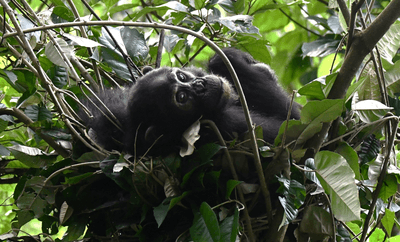


A study of chimpanzees in the mountains of Rwanda shows our nearest relatives adapt their nests to account for extremely localized weather conditions. More tentatively, these decisions might reflect an ability to predict overnight weather, rather than simply reacting to the weather when the nest is being made.
Chimpanzees make tree nests for comfort, warmth, and to give themselves some protection against wind and rain. Studies of this nesting behavior have mostly been done in relatively warm and dry lowland environments.
University of Western Australia PhD student Hassan Al-Razi thought the high mountains of Nyungwe National Park, Rwanda, were a more interesting research location since the colder temperatures and more changeable weather make nest choices more important and challenging.
After tracking a community of 67 chimpanzees through the forest, Al-Razi and his co-authors observed the chimpanzees making their nests as nightfall approached.
The next morning, a skilled climber in Al-Razi’s team took measurements of features like depth and the amount of insulation in the now abandoned nests. These observations were compared with weather conditions both at the time the apes settled down and overnight.
Some clear patterns emerged: “Chimpanzees preferentially constructed nests in warmer, less windy microclimates, built thicker and deeper nests under cooler or wetter conditions, and selected taller trees with denser canopy cover prior to rainy nights,” the authors write.
It’s the last part that has the biggest implications. While nesting in more protected locations increased when it was raining as the nest was being built, there was an even stronger relationship with this behavior and overnight rain.
Not surprisingly, weather conditions when the nests were being built and overnight were strongly related. The authors admit the chimpanzees may have just been choosing warmer and drier nests when it was already cold and rainy, and they just happened to get lucky when overnight conditions matched their choice.
However, the closer relationship suggests the chimps may have the capacity to predict the weather and make their decisions based on foresight, not just how they felt at the time.
That would be an important finding for our understanding of ape intelligence, but it wouldn’t be unprecedented. The authors point to research in other animals, particularly birds, that can detect barometric pressure changes and use this to flee coming storms. Folklore, of course, is full of more elaborate examples.
Al-Razi told IFLScience that it wasn’t clear whether each chimpanzee was making its own assessment of the weather or if being a weather forecaster is a trusted role in a troop, with others taking advice. The latter option is made more plausible by observations that the chimpanzees preferred the western slopes of mountains before colder nights, presumably so they could catch the last sunlight after retiring to their nests, forcing some collective decision-making.
The team also found no difference based on the age or sex of the chimps in their ability to match their nest-building to weather conditions: “An adult might make the decision and a subadult follow along,” Al-Razi told IFLScience.
“A recent publication showed juveniles and subadults learn nest-making from their mothers and siblings,” he said. At this stage, however, it’s speculative how much copying occurs.
Each chimpanzee spends 1-3 minutes each night making a nest, said Al-Razi. Consequently, it isn’t clear why they don’t just put the extra effort into making more insulated nests every night, just in case they get the weather wrong. Perhaps they’re just too lazy (they’re our cousins after all), but apparently, they aren’t lazy enough to reuse nests from the night before, something done only infrequently.
Previous studies in warmer conditions showed that on cold nights, Senagalese chimpanzees climb higher into the trees, apparently to avoid wetter air near the forest floor, but their behavior lacked the complexity seen here.
Al-Razi told IFLScience that past research on the topic neglected high-altitude chimpanzees partly because their movements are harder to follow. Moreover, he noted that we think humans' and chimpanzees' last common ancestor lived in a savannah environment, so researchers focus more on the behavior of chimps living in similar environments today.
The study is published in Current Biology.