Nature
 PUBLISHED
 3
3


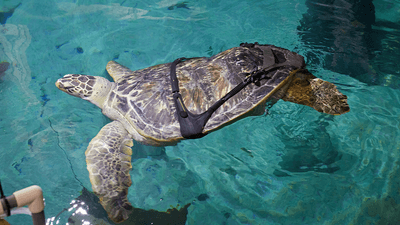


Unfortunately marine animals often run into issues with boats, which either cause fatalities or have serious, often long-term consequences for the animal. Mystic Aquarium is home to Charlotte the green sea turtle, who has “bubble butt” syndrome, causing Charlotte’s behind to lift up out of the water as air is trapped in his shell. The syndrome is caused by trauma, usually run-ins with boats, but the team at Formlabs have come up with an ingenious method to help Charlotte.
Charlotte is a male green sea turtle who lives at Mystic Aquarium, Connecticut, USA. In 2008, Charlotte was found in Jekyll Island, Georgia and rescued after it became clear that the condition was making it difficult for him to swim effectively and find enough to eat.
Over the years the team at Mystic, including veterinarians, have tried numerous methods to counteract the bubble butt, also known as positive buoyancy syndrome. The team tried a weighted strap belt that unfortunately was not successful, and other solutions have been rubbed off on the side of the tank, or caused shell irritation for Charlotte.
The team realized that custom 3D-printing a harness to hold the weights could provide a much better outcome for Charlotte. This method meant that the harness could be made to Charlotte's exact specifications and fit his unique shell shape.
“The problem we have been trying to solve is essentially putting weights on the back of Charlotte, which sounds very simple, but it ended up being a very challenging process. The only way to really get something to stick to Charlotte was to build a custom device,” said Nick Gondek, Director of Additive Manufacturing at Adia, who partnered with Formlabs on this project, in a blog post.
A combination of scans and computational design was used to make Charlotte's harness. The harness fits around his shell and has space for weights to help balance out the effect of the bubble butt syndrome. The material was printed on a selective laser sintering (SLS) 3D printer, making the harness high quality but without adding too much extra weight; the custom material was also slightly flexible to accommodate Charlotte's movements in the water.
“We've looked at many different 3D printing processes for this project and we landed on SLS for a few reasons. One is the build volume, and size of components. Two is that we could build parts without supports. And three was we could find the proper materials that had the rigidity we needed for this project,” said Gondek.
When the time finally came to test the harness on Charlotte, the entire team was nervous, but the harness seemed a success!
“It's looking like a very positive interaction. It's been a little bit since we last put the harness on him. So this new version of the harness is so far seeming like a really good addition for him. And as we're getting him to wear it more and be more consistent, we'll be able to add the weights back in and just see how he tolerates it. But for now, it's a really positive sign that he's doing well with it right off the bat,” said Claire Bolster, Aquarist at Mystic Aquarium.