Nature
 PUBLISHED



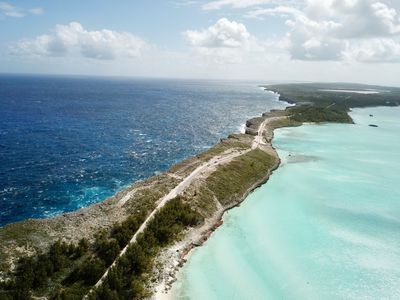


Deep, brooding blue on one side and perky turquoise on the other: this is where the North Atlantic Ocean meets the Bight of Eleuthera.
The striking sight is best seen at the Glass Window Bridge, the thinnest part of Eleuthera, a sleepy, skinny island in the Bahamas. Here, two drastically different-looking bodies of water are separated by a road and a strip of rock less than 10 meters (30 feet) wide.
The contrast between the two is dramatic, but the divide isn’t as harsh as it first appears. Look at it on a map, then zoom out, and you’ll see that Eleuthera is like a little bracket with its back to the Atlantic.
Nestled along the inward-facing curve, the Bight of Eleuthera (sometimes confused with the Caribbean Sea, which is actually much farther south) is shallower and more sheltered. Protected from strong currents and the Atlantic’s powerful rhythms, less sand and sediment are stirred up, allowing the water to remain clear and bright.
On the outward-facing side of the curve, the lively and deep waters of the Atlantic are reflected in its richer, darker color.
Maps can sometimes make oceans and seas appear to have sharp, rigid borders, almost like national boundaries. In reality, seawater doesn’t adhere to such precise divisions. While we may label one area “the Atlantic” and another “the Caribbean”, the water itself flows and blends freely.
That’s not to say oceans and seas lack distinct characteristics that are worth slapping a label on. Different seas and oceans do vary in salinity, biodiversity, temperature, overall temperament, and sea level, but the differences between their waters are rarely clear-cut or easily delineated by eye alone.
For example, you might have seen viral videos claiming to show the boundary between the Atlantic and the Pacific at the bottom of South America, where one side is vibrant blue and the other is murky brown. Unfortunately, most of these videos are misleading – the color difference is usually elsewhere in the world and caused by sediment, glacial meltwater, lighting, or camera angles, rather than showing a true meeting of two unmixed oceans.
At the Glass Window Bridge in the Bahamas, however, we do get to experience a rare and genuine visual contrast between two bodies of water shaped by depth, exposure, and geography.