Nature
 PUBLISHED
 6
6


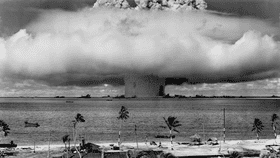


Bikini Atoll might sound like an idyllic island getaway, but any visitors would be better off wearing a biohazard suit than swimwear, as the nuclear fallout from tests carried out by the US military over 60 years ago has left parts of the Marshall Islands more radioactive than Chernobyl.
In the aftermath of the hydrogen bombs that devastated Hiroshima and Nagasaki in 1945, the US and Soviet governments entered into a nuclear arms race that became known as the Cold War. Like rival baboons trying to intimidate each other with the size of their bottoms, neither side ever actually pushed the button, but both engaged in some serious nuclear posturing, setting off mushroom clouds in remote testing sites as a display of their might and stupidity.
Between 1946 and 1958, the US conducted almost 70 nuclear bomb tests in the Marshall Islands, a chain of atolls and volcanic islands in the central Pacific Ocean, roughly halfway between Hawaii and the Philippines. The largest of these detonations was codenamed Castle Bravo and released the equivalent of 15 megatons of TNT in Bikini Atoll on March 1, 1954. Now that’s a spicy meatball.
The explosion completely vaporized a nearby artificial island and left a crater measuring 1.5 kilometers (1 mile) in diameter and 75 meters (245 feet) in depth.
Radioactive fallout from Castle Bravo made the atoll unsafe for human habitation, and researchers from Columbia University have now analyzed radiation levels in the Bravo crater, with some shocking results.
Publishing their findings in the Proceedings of the National Academy of Sciences, the authors explain how they dove to depths of around 60 meters (225 feet) to collect 129 samples of sediment from different points across the crater. Levels of certain nuclear isotopes – including plutonium-(239,240), americium-241, and bismuth-207 – were found to be at least an order of magnitude higher than in other nearby atolls, and many times above the legal exposure limit agreed by the US and Marshall Island governments.
These results build on existing research indicating that the long-term effects of nuclear testing may be further-reaching than previously imagined, altering the environment to such a degree that they may have even ushered in a new geological age.