Space and Physics
 PUBLISHED


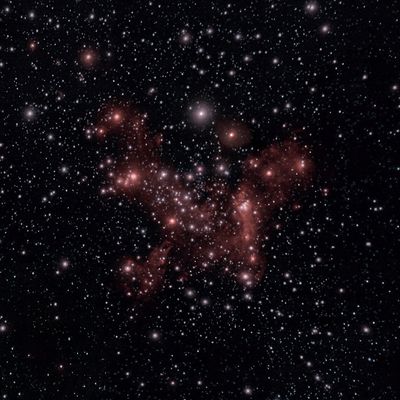


At the very center of our galaxy sits a supermassive black hole that we call Sagittarius A*. It weighs 4.3 million times the mass of the Sun, and it exists in a compact region, just 44 million kilometers (27.3 million miles) across. It is not there alone. It is surrounded by stars, moving around at high speed and feeling its gravitational effects. It is also surrounded by peculiar gas clouds, and scientists believe they have worked out where they come from.
In new observations from the European Southern Observatory’s Very Large Telescope, scientists have spotted a third gas cloud joining the already known gas clouds G1 and G2. The new one is called G2t, and if you are wondering why it is not G3, it’s because that name has already been used for a different, unrelated object.
The origins of G1 and G2 have been debated, and whether they are pure gas clouds or are hiding a star inside was not completely clear. With the new discovery, we have some answers. G1, G2, and G2t are now believed to be more related than previously thought.
G2t is thought to have originally been an outer tail from the G2 cloud, visible at the time of discovery in 2008, and now fully independent. The team goes a step further in linking the gas clouds, connecting them with the original discovery G1. The crucial finding is that they all seem to be on the same orbit.
A possible explanation for G2 put forward years ago was that the clouds hid a secret star with a large fuzzy atmosphere. The new work shows that G1, G2, and G2t are all in extremely similar orbits. Their motion looks the same; they simply appear slightly rotated. Even without consideration of how extreme the center of our galaxy is, something that the new Central Molecular Zone image of the Milky Way can attest, the scenario that these three randomly have equal orbits seems a bit suspicious.
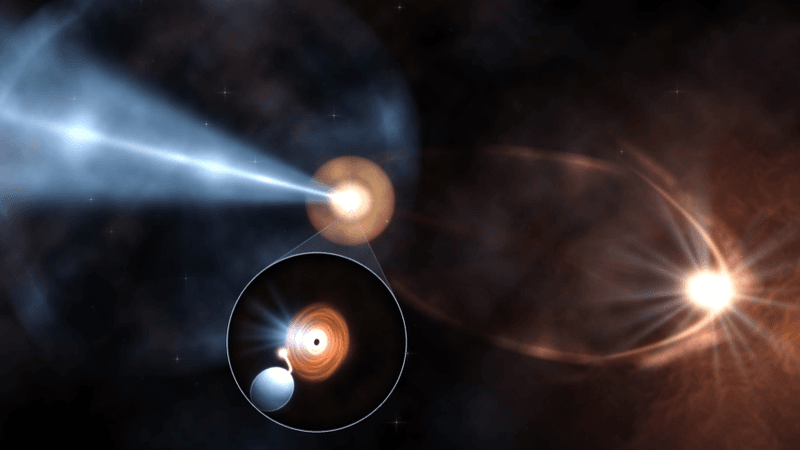
The explanation put forward here is that these gas clouds are the product of the stellar winds of massive binary star IRS 16SW. Those stars are losing loosely attached outer layers, and those layers are zipping up in clumps around Sagittarius A*. The stars eject material with a slightly different trajectory, which gives rise to the small differences in their similar orbits.
The heart of our galaxy continues to reveal surprising findings and mysteries.
The study is published in the journal Astronomy & Astrophysics.