Nature
 PUBLISHED
 1
1


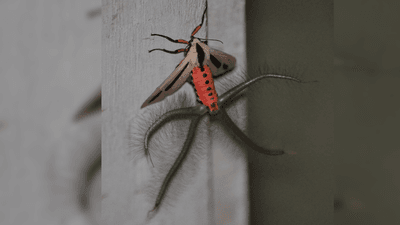


While we’re all sad that season five of Stranger Things has been and gone, fear not, the creatures of planet Earth have just as much freaky appeal as a demogorgon from the Upside Down. Meet the Baphomet moth, a frankly terrifying-looking creature from, you guessed it, Australia.
The Baphomet moth (Creatonotos gangis) is also known as an Australian horror moth, though it's actually native to Southeast Asia as well as northern Australia. For most of the time, it looks like a regular member of the tiger moth family, with a red and white wing and a larger wingspan of 4 centimeters (1.6 inches). However, this colorful creature has evolved an ingenious, albeit slightly worrying-looking way to find a mate, even if there are none to be seen.
Rather than make a loud noise like other insects, the Baphomet moth males whip out a series of structures called hair pencils, or coremata. It's thought that these structures are where the moth gets its name from; they superficially resemble the horned occult deity of the same name. However, the structures produced by the moth aren’t horns; they’re much more specialized than that.
These hair pencils are used to spread the smell of the male’s pheromone, called hydroxydanaidal, far and wide, attracting females. When not in use, they are simply deflated away inside the abdomen.
What’s even more interesting is the way the pheromones are created. In their caterpillar form, the Baphomet moth feeds on plants that produce pyrrolizidine alkaloids, compounds that normally deter predators from eating the leaves and can sometimes cause poisoning. However, not so for our intrepid moth, which will consume enough as a caterpillar to produce pheromones as an adult-form moth by modifying the chemicals. Not eating enough of these compounds can even mean that the moth won't be able to produce hair pencils in the future, while the more it eats, the longer and more impressive its hair pencils will be.
Turns out for the Baphomet moth, size really does matter.