Nature
 PUBLISHED


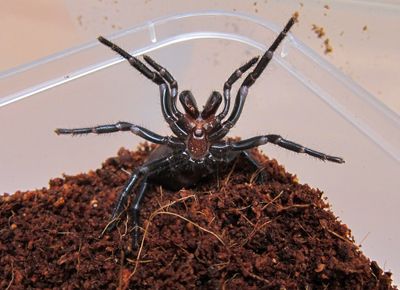


Australia might be home to a large proportion of the world’s deadliest animals but it's about to have three more. The iconic Sydney funnel-web spider, with one of the world’s deadliest bites, has been discovered to be three species instead of one, each with a separate geography to match.
Considered the spider with the most dangerous venom for humans, the Sydney funnel-web spider was considered one species with a large distribution. What tipped the researchers into thinking that there might be something amiss is that the spiders in different regions were quite different in appearance and had a high variability in their venom.
Unusually large funnel-web males were brought to the Australian Reptile Park as part of the venom program, which led researchers to begin comparing the species. Kane Christian received the large males and now gives his name to one of the new species.
“Atrax christenseni is a superb and impressive funnel web. The sheer size of the males, compared to the males of the other Atrax species is simply astounding. I am very passionate about funnel-webs and there is no greater compliment than to have another scientist name a funnel-web species after me. I am deeply honoured and accept it with great pleasure,” Christensen said in a statement.

Using a combination of anatomical and DNA comparisons, the team have reclassified the species into three.
The Newcastle funnel-web (Atrax christenseni) also known as “Big Boy” is the largest of the three and occurs only near the city of Newcastle, north of Sydney. The second species, the Southern Sydney funnel-web (Atrax montanus), is most typically found in the Blue Mountains to the south and the west of Sydney; and the final species is the original Sydney funnel-web (Atrax robustus) found throughout the Sydney Basin. The Sydney funnel-web and the Southern Sydney funnel-web do overlap in their species range.
The team also think that the species have slightly different preferred habitats, with the Sydney funnel-web preferring open and closed woodlands, the Southern Sydney species occurring in rainforest and drainage lines, while more work needs to be done to find the preferred areas for Newcastle funnel-web.
“Our research uncovered hidden diversity among funnel-web spiders,” noted lead researcher Dr Stephanie Loria of the Leibniz Institute for the Analysis of Biodiversity Change. “The Newcastle funnel-web, Atrax christenseni -'Big Boy'- is a totally new species. The 'true' Sydney Funnel-web, Atrax robustus centres on the North Shore of Sydney and the Central Coast, and the Southern Sydney Funnel-web, Atrax montanus is a resurrected species name from 1914,” Dr Loria said.” None of these insights would have been possible without the use of historical collections and international collaboration.”
Considering the iconic nature of this species, most studies have focused on the venom properties rather than the taxonomic or morphological characteristics of the spiders. An antivenom was developed for the species in 1981 and since then no fatalities have occurred. The team think that having the separated species could lead to more effective antivenoms for each of the species in the future.
The paper is published in BMC Ecology and Evolution.