Space and Physics
 PUBLISHED


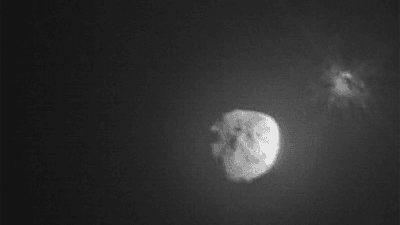


A new study appears to have found evidence of a binary pair of asteroids transferring material to each other, the first direct evidence of such events.
If you aren't too hot on asteroids, you might not be picturing them as having a buddy. But around 15 percent of these objects that pass near the Earth have a smaller chunk of space rock orbiting around them. We have been studying these binary asteroid systems for some time now, but one in particular has been studied up close and personal by NASA: Didymos and its smaller moonlet Dimorphos.
In 2022, NASA slammed a spaceship into Dimorphos, a planetary defense test to see if we could deflect an asteroid should the need arise in the future. As well as successfully redirecting the moonlet, which is around 160 meters (525 feet) in diameter, it sent huge boulders flying off from the loosely bound smaller asteroid, ranging in size from 1 to 7 meters (3-23 feet) in diameter. Simulations suggest that some of these chunks of debris may hit Didymos or Dimorphos.
But looking back through the data, researchers led by the University of Maryland found something interesting. Before the test had been conducted at all, and the asteroid remained unslammed, there appears to be evidence of material exchange between the binary pair.
Asteroids grow through collisions of smaller rocks and are held together (often very loosely, particularly in "rubble pile" asteroids) through their own gravity. When radiation from the Sun hits an asteroid, it warms it. Later, as this heat is released as infrared radiation, it also carries with it a little angular momentum, too, slightly affecting how it spins. Eventually, this spin can be enough to overcome the object's gravity, sending debris flying away from the asteroid, known as the Yarkovsky–O'Keefe–Radzievskii–Paddack (YORP) effect after the scientists who first proposed it.
"This process creates a tiny torque that can cause the asteroid to continually spin faster," NASA explains. "When the resulting centrifugal force starts to overcome gravity, the asteroid’s surface becomes unstable, and landslides may send dust and rubble drifting into space at a couple of miles per hour, or the speed of a strolling human."
Near-Earth binary asteroid systems are believed to have emerged via this process, the asteroid building up so much spin over many years (in the case of one asteroid system, over 100 million years) that they spin themselves apart and create their own moonlets. While telescopes have provided us with some evidence for this process, in the Double Asteroid Redirection Test (DART) data, the team found bright, fan-shaped streaks across Dimorphos's surface.
"At first, we thought something was wrong with the camera, and then we thought it could've been something wrong with our image processing," lead author Jessica Sunshine, a professor at the University of Maryland (UMD), said in a statement. "But after we cleaned things up, we realized the patterns we were seeing were very consistent with low velocity impacts, like throwing 'cosmic snowballs.' We had the first direct proof for recent material transport in a binary asteroid system."
The team ran simulations, as well as analog experiments, to test if it matched the streaks seen on Dimorphos, once they had established that they were really there, and not the result of lighting conditions or the geometry of the asteroid. Delightfully, this involved dropping marbles into playground sand.
This, and the simulation, produced streaks similar to those seen on an asteroid all that way from Earth.
"As we refined our 3D model of the moon the fan-shaped streaks became clearer, not fainter," Tony Farnham, another astronomer at UMD, explained. "It confirmed to us that we were working with something real."
Attempting to simulate the impact, the team found that the debris must have left Didymos at around 30.7 centimeters (~12 inches) per second, slower than the average human walking speed.
"That would explain the distinctive fan-shaped marks," Sunshine added. "Instead of even spreading, these slow-moving impacts would create a deposit rather than a crater. And they are centered on the equator as predicted from modeling material spun off the primary."
The study provides the first visual evidence of this YORP process of forming binary asteroid systems, hinting at regular exchange of material between asteroid and moonlet.
"These new details emerging from this research are crucial to our understanding of near-Earth asteroids and how they evolve," Sunshine added. "We now know that they're far more dynamic than previously believed, which will help us improve our models and our planetary defense measures."
The study is published in The Planetary Science Journal.