Space and Physics
 PUBLISHED




What you'll discover in this article
- Samples of material we collect from extraterrestrial environments may contain lifeforms that pose a risk to Earth.
- The best place to quarantine and study these samples, according to a new paper, could be the Moon.
- Study author Dr Frederick Moxley told IFLScience, "The Moon provides an optimal location for extraterrestrial sample quarantine due to its unique combination of isolation and accessibility."
- NASA has previously committed to plans to build a Moon base, which could house a future biocontainment lab.
A lot of planetary protection protocols worry about how we might accidentally spread terrestrial life to other places in the Solar System – after all, we are the one sending probes left and right.
However, some of those probes come back with samples. What would happen if some of those samples contained lifeforms and started spreading on Earth? To avoid that scenario, Drs Frederick Moxley and Anthony Ricciardi have looked to the Moon to keep us safe.
Their idea is simple. Instead of bringing samples directly to Earth, we take them to a lab on the Moon. There, if a sample were to contain lifeforms, a potential leak would be contained. It would be a lot more concerning if that scenario were to happen on Earth.
The Moon provides an optimal location for extraterrestrial sample quarantine.
Dr Frederick Moxley
“For instance, if a sample contained an extraterrestrial lifeform with a molecular architecture that reflected atypical biochemistry (e.g., alternative nucleic acid analogs or chirality reversal), and were to be accidentally released into the Earth’s biosphere, it could prove hazardous to both humankind and our ecosystems – leaving us little recourse, other than just dealing with it,” Dr Moxley from Strategic Threat and Analysis Research Laboratories, told IFLScience.
We are yet to find any evidence of extraterrestrial life in the Solar System. The best so far is the Cheyava Falls sample on Mars, and it is the very vague “detection of a possible signal.” We are also in no rush to go pick it up for proper lab analysis, since the Mars Sample Return mission was canceled.
A "biological firewall"
Still, labs on Earth might be necessary to confirm the presence of biological samples. Our robots in space might be good, but we need our full scientific arsenal to study extraterrestrial material that might be hiding lifeforms. Doing that while being safe might require the Moon.
“The Moon provides an optimal location for extraterrestrial sample quarantine due to its unique combination of isolation and accessibility,” Dr Moxley told IFLScience.
“It lies close enough (approximately three days' travel through space) to support logistic and communication abilities, yet is far enough to provide an effective biological firewall between Earth and any potential alien lifeforms.”
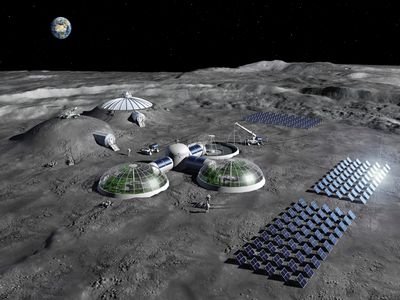
A lab on the Moon would obviously have its own challenges, but they would be solved with the construction of a Moon base. We do not yet have a base on the Moon, but NASA is pretty committed to it, and it would be worth considering whether a biosafety laboratory should be part of those plans.
There have been extraterrestrial samples brought to Earth already, from the Moon as well as asteroids. We do not expect those places to have life, but precautions were taken, mostly to protect those samples from our planet’s environment (rather than vice versa). A test showed that bacteria can easily spread onto extraterrestrial samples.
That said, the Outer Space Treaty has an article about protecting Earth from celestial contamination, and the proposal here is on the basis of the precautionary principle: Better safe than sorry. This was actually the title of a paper Dr Moxley wrote two decades ago on the same subject.
Now that a Moon base appears to be realistically on the cards thanks to the Artemis Program, the idea is suddenly very viable if taken seriously.
“My real concern is that Planetary Protection measures may be viewed as an afterthought,” Dr Moxley told IFLScience.
“Hopefully, they will not be. Especially as humankind continues to explore outer space and visiting other celestial bodies (to include planets, moons, asteroids, etc).”
Planetary protection should be a major concern and it goes both ways. We should be careful what we send out there, as we might mess up an alien biosphere. Even if there are no aliens, we might be sending earthly pathogens on a journey that would make them more dangerous to us, as a recent study has highlighted
The lunar biocontainment proposal paper is published in the journal Ambio.