Nature
 PUBLISHED


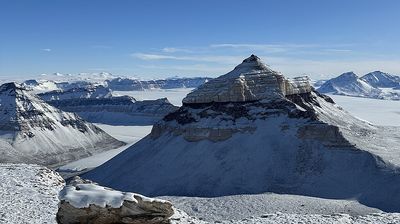


Antarctica’s Lake Enigma has become slightly less enigmatic. It was once assumed the faraway lake was frozen solid from top to bottom, but scientists have now discovered a massive hidden body of unfrozen water beneath its chunky ice surface. Here, amid the frosty waters, they found a unique ecosystem teeming with life.
Lake Enigma is a lake found in the Northern Victoria Land of eastern Antarctica. The presence of liquid water was recently discovered by a team from the Italian National Research Council of Italy using ground-penetrating radar, contradicting earlier assumptions that it was completely frozen.
Their scans suggest the water is at least 12 meters (39 feet) deep, although they write that it “may be even deeper.”
The lake is subjected to average air temperatures of –14°C (6.8°F), with lows reaching –40.7°C (-41.26°F). Thanks to these bitter temperatures, the unfrozen water remains covered by up to 11 meters (36 feet) of ice all year round.
The permanent ice cover helps to isolate the lake from the external world and, along with the extreme cold, fosters a unique ecosystem of microorganisms – some of which might not be found anywhere else on Earth. The microbial ecosystem in Lake Enigma even seems to be unlike other Antarctic lakes, such as those living in the well-studied McMurdo Dry Valleys, likely due to its unique chemical and thermal properties.
Genetic analysis of samples taken from the lake revealed a variety of different microorganisms dwelling in the water, including Bacteroidota, Actinobacteriota, and Pseudomonadota.
Most significantly, it showed that the water was enriched by an abundance of ultrasmall bacteria of the superphylum Patescibacteria. These tiny bacteria have extremely small cells, contain highly reduced genomes, and carry out very minimal cellular activities. They are simple but effective.
“The ice-sealed planktonic and benthic microbiota of Lake Enigma likely represent persistent legacy biota that arose from the lake’s ancient microbial ecosystem before the freeze-up,” the study authors write.
“Overall, Lake Enigma microbiota occupy different trophic levels within a simple aquatic food web, ranging from primary production to ectosymbiosis and predation. The ultrasmall Patescibacteria in particular may play unusual roles in the lake’s ecosystem that do not play out in other ice-covered Antarctic lakes,” they add.
It’s bizarre that the body of water even exists. Antarctica is the largest desert on Earth because it receives so little rain or snow. Due to this lack of precipitation, along with intense evaporation from the sun and super-gusty winds, the lake should lose up to 200,000 cubic meters (7,062,933 cubic feet) of water each year. Despite this, its waters have not depleted.
This led the researchers to claim the lake must have a hidden recharge system. The source of the replenishing water remains unclear, but I guess they call it Lake Engima for good reason…
The new study is published in the journal Communications Earth & Environment.