Nature
 PUBLISHED
 9
9


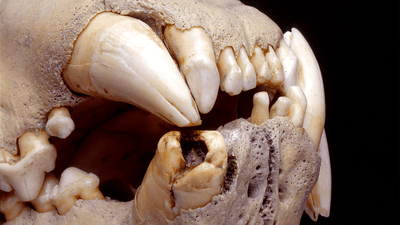


In 1898, a pair of lions repeatedly raided the tents of an encampment in Kenya, killing at least 28 people. The infamous "Tsavo man-eaters” were eventually shot and their remains put on display at the Field Museum Of Natural History in Chicago, and now a new genomic study has revealed the grim story their teeth have to tell.
The Tsavo lions – immortalized in the 1996 Michael Douglas/Val Kilmer movie The Ghost and the Darkness – may have been dead for well over a century, but we’re still learning from them and, more specifically, the compacted hairs squished inside their mouth bones (interestingly, bad teeth may explain why some lean towards eating people more than others). It’s a great example of how new technologies can provide fresh insight into cold cases, and adds to the already rich roster of uses we have for museum specimens.
“As biotechnologies advance, there are unexpected sources of knowledge, in this case genomics, that can be used to inform about the past,” said Ripan Malhi of the University of Illinois Urbana-Champaign in a statement. “Our results inform on the ecology and diet of lions in the past as well as on the impacts of colonization on life and land in this region of Africa.”
Malhi and colleagues set out to innovate a method that would enable them to extract and analyze the DNA stored within these hair samples, and in doing so, reconstruct the diet of these infamous lions. Their investigations took a deep dive into tiny dental injuries on their canines where exposed cavities contained the hairs of their prey that had built up over time.

They then extracted DNA from individual hair shafts, and while it wasn’t perfect, it was enough to paint a picture of the species that were a part of their diet. The results showed that their “man-eater” status was well earned, as human DNA was detected along with that of giraffes, oryx, waterbucks, wildebeest, and zebra.
Their man-eater ways were infamous, but the fact that wildebeest was on the menu was quite a surprise. Why? Because wildebeest would not have been local.
“It suggests that the Tsavo lions may have either traveled farther than previously believed, or that wildebeest were present in the Tsavo region during that time,” said Alida de Flamingh, also at the University of Illinois Urbana-Champaign. “The closest grazing area for wildebeest was over 50 miles [80 kilometers] from where the lions were killed in 1898 at the Tsavo-Athi confluence.”
The researchers aren’t done with the Tsavo lions just yet. The next step is to go into even greater detail with the compacted hair samples, with hopes they may be able to separate out their dietary preferences based on the lions’ age. Doing so doesn’t just demonstrate the potential of genomic research, but could also provide new insights into historic human-lion conflicts that could even be applied to specimens older than the Tsavo lions.
“This methodology can potentially be used on hairs from broken teeth of more ancient carnivores from hundreds to thousands of years ago,” Malhi added. “[It] opens up a new avenue of inquiry into the past.”
The study is published in the journal Current Biology.