Nature
 PUBLISHED


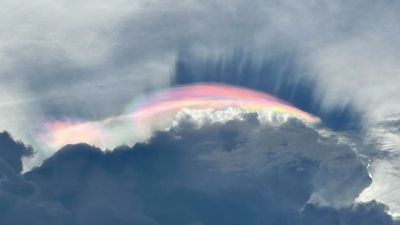


In a world where it’s becoming increasingly difficult to tell what’s AI-generated vs. the real thing, it’s no surprise that we’re all a bit more skeptical of anything that looks too good to be true – including the videos of beautiful “rainbow clouds” that’ve been going viral recently. Turns out though, they’re very much real.
The brightly colored clouds were spotted over Jonggol, Indonesia, on April 1, catching the eyes of people in the area, who started sharing photos and videos of the unusual phenomenon on social media. These quickly racked up far more views than your average sunset pic – and with them, suggestions as to what was the cause.
“It’s just Zara Larsson filming a new music video,” quipped one commenter on a TikTok post of the clouds, while another told people to “watch out for Mario falling out of the sky in a kart.”
Then there were those who questioned the authenticity of the videos, suggesting that they were made using artificial intelligence. However, in this case, the rainbow cloud show was a real example of an optical phenomenon known as cloud iridescence.
Cloud iridescence typically occurs in altocumulus, cirrocumulus, lenticular, and cirrus clouds, and it requires two main ingredients: sunlight and lots of tiny, relatively uniformly sized water droplets or ice crystals within the cloud. The cloud that these tiny particles are in also needs to be thin, and the Sun needs to be at a particular angle.
That’s a lot to get right – and explains why this phenomenon is relatively rare. But, when everything falls into place, rays of sunlight hit just a few droplets or crystals at a time and get scattered (the proper term for this is diffraction). Collectively, this produces the spectacular array of colors seen in cloud iridescence.
Water droplets and ice crystals in the atmosphere play a part in many of the other colorful phenomena that can grace Earth’s skies too, including the psychedelic polar stratospheric clouds seen in the Arctic come the winter, the eerie pilot’s glory, and circumhorizontal arcs, better known (albeit incorrectly) as “fire rainbows”.
Pastel candy-colored clouds aren’t just restricted to our planet either. Thanks to the dry ice, or frozen carbon dioxide, in the atmosphere, they can also appear on Mars in the form of stunning noctilucent clouds. Seen on Earth too, these “night shining clouds” are found high in the atmosphere, cropping up when the Sun is just below the horizon.
All “explainer” articles are confirmed by fact checkers to be correct at time of publishing. Text, images, and links may be edited, removed, or added to at a later date to keep information current.