Nature
 PUBLISHED
 4
4


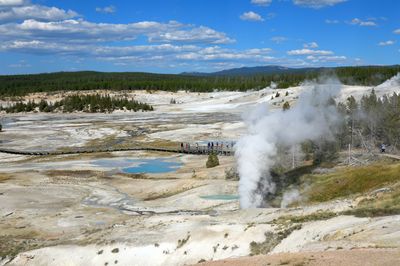


With its vibrant technicolor thermal springs, abundant wildlife, and looming apocalyptic threat, Yellowstone is nothing if not cinematic. But not all of the geological phenomena that make the place special are so dramatic.
Take the Norris Uplift Anomaly, for example: an area about 29 kilometers (18 miles) across lying along the north rim of the Yellowstone caldera which, local geologists now confirm, has started “deforming” under their very feet.
So, uh, here’s a question: what does that mean? And, you know… should we worry?
Deformations in the ground
“Yellowstone is a dynamic geologic system – the one constant is change.” So wrote Michael Poland, a geophysicist with the US Geological Survey (USGS) and Scientist-in-Charge at the Yellowstone Volcano Observatory, in a recent update to the Observatory’s regular Caldera Chronicles column.
“This is demonstrated daily by hydrothermal activity manifested in geysers, hot springs, mud pots, and other thermal features,” he wrote. But that’s not all: “even the ground itself moves!”
To geologists and volcanologists, it’s known as “deformation”: the changes in shape of a landscape around a volcano caused by the movement of magma beneath the surface. It’s particularly prevalent in a place like Yellowstone, sitting as it does right on top of a volcanic hotspot – an unusually hot area thought to be fed from magma deep within the Earth.
“It's conceptually similar in some sense to what happens when you put a pot of water on your stove,” explained Leif Karlstrom, an earth scientist at the University of Oregon, in a November 2025 video for PBS Terra. “It's heated from the bottom and cooled from above, and the hotter fluid is less dense, so it rises and it circulates. And that's what's going on in the solid earth under our feet all the time.”
This endless churning and motion, when not producing all-out volcanic eruptions, can cause the ground to literally swell and bend. Deformation can manifest as an uplift or inflation, occurring when the pressure under the ground increases for some reason, or subsidence or deflation when it decreases. “These changes can be driven by a variety of processes, like fault motion, accumulation or withdrawal of magma or hydrothermal fluids, and even cooling and contraction of subsurface fluids,” Poland explained.
And, for a long time, it did just that.
The Norris Uplift Anomaly
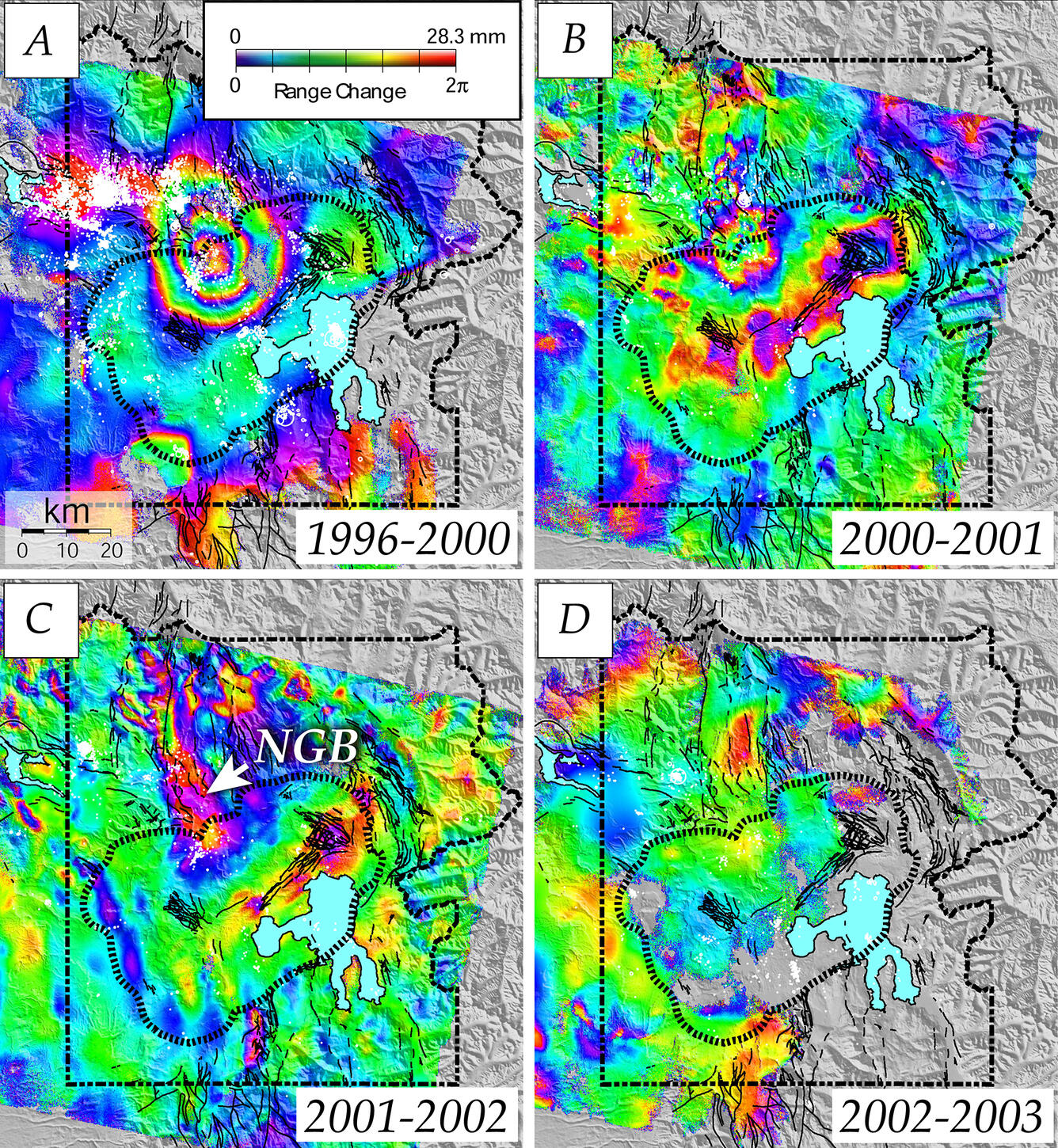
For nine years between 1996 and 2004, “an area along the north caldera rim, just south of Norris Geyser Basin, uplifted by a total of about 12 centimeters (almost 5 inches),” explained Poland. “This deformation came to be known as the Norris Uplift Anomaly (NUA), and it was thought to be a result of accumulation of magma 14 kilometers (almost 9 miles) beneath the surface.”
Radar interferograms from the 1990s showed a clear ripple pattern in the surface, centered close to the middle of the park; eventually, this pattern dispersed, as various areas in Yellowstone rose or sank with the movement of magma. And, to be fair, this was almost certainly not a new phenomenon: “This sort of activity is probably quite common, but it is only thanks to the technological innovations and expanded monitoring networks of the past few decades that such minor changes can be detected,” wrote Poland.
From its swollen peak in 2004, the NUA then spent the next decade or so subsiding, losing more than half of the height it had gained in the previous one. That’s not surprising: “When magma intrudes the crust it cools, crystallizes, and releases gases that had been dissolved in the melt,” explained Dan Dzurisin, emeritus geologist with the USGS, back in 2020. “Gas escape lowers pressure in the magma, causing the surface to subside. That's probably what was going on.”
But in 2013, the situation flipped again: the area started inflating at the highest rate ever measured in Yellowstone – more than 15 cm (5.9 inches) per year. This was likely due to gas getting trapped under an impermeable layer of rock, resulting in increased upward pressure forcing the ground up at an unprecedented rate.
It didn’t last. In true Yellowstone fashion, the end came swiftly and dramatically, with a magnitude 4.9 earthquake – the largest in the area since the 1970s. For the next 20 months or so, Norris was all subsidence. “It seems likely the quake created microfractures that allowed gases to escape upward again, resulting in subsidence that ended in 2015,” explained Dzurisin.
The ground continued alternately uplifting and subsiding like this – albeit to a less impressive degree – until 2020, when Norris seemed to calm down. “No significant changes occurred after 2020,” Poland wrote. “Until now.”
Return of the NUA
Starting in July last year, GPS stations near Yellowstone caldera started moving again. It wasn’t by much: by September, the ground was only 2 centimeters (0.79 inches) higher than before, and had moved horizontally by half that.
But when scientists checked the interferometry data, it was confirmed: “The pattern of uplift was very similar to that of 1996–2004,” Poland reported. “It was clear. The NUA was back!”
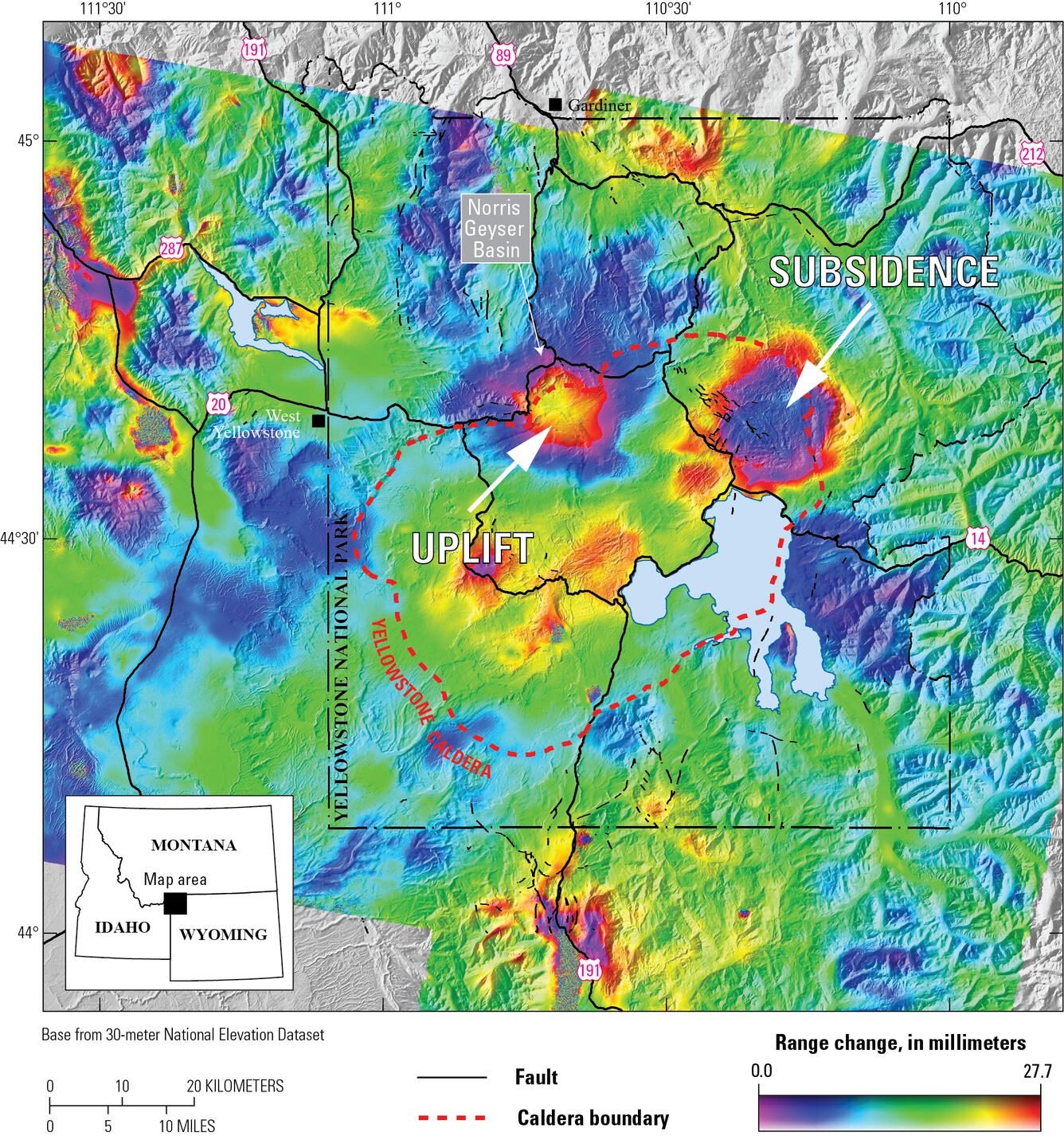
It wasn’t just geological movement. The site also saw an uptick in seismic activity, including a “swarm” of more than 100 earthquakes in an area near the NUA – possibly as a response to the stresses of geological movement and increased pressure.
Such an increase in concentrated activity might make you wonder: should we be worried? Is this the start of Yellowstone’s fabled “big one”? And we’re delighted to inform you that, no, everything is fine. The activity seen lately, while noteworthy, is pretty minor overall – certainly nothing compared to the kinds of warning signs we’d get if Yellowstone were about to blow – and in any case, it’s probably very normal for volcanic hotspots like Yellowstone. As Dzurisin pointed out, “What's different is that we now have the tools to detect and model Yellowstone's ups and downs better than ever before.”
“For those in the know […] that's awesome,” he wrote. “Not alarming.”