Nature
 PUBLISHED


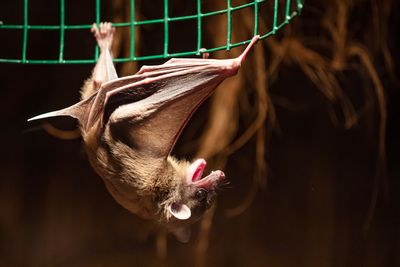


As if its name didn’t warn you enough, there are many good reasons to avoid Python Cave in Uganda. Chief among them is that the cavern is home to a roost of bats known to harbor Marburg virus, the pathogen that causes a viral hemorrhagic fever similar to its more infamous cousin, Ebola. However, recent research has shown that the cavern is frequently approached by humans, as well as other animals that prey on the infected bats. Needless to say, this is very bad news.
Scientists at the Volcanoes Safaris Partnership Trust recently set up a series of camera traps at Python Cave in Queen Elizabeth National Park, a vibrant ecosystem in western Uganda. Over 368 nights, they observed the many different species that entered the cavern and documented their behavior.
The researchers recorded more than 300 wildlife encounters in the cave involving at least 14 different species. This included reptiles like the Nile monitor; mammals such as leopards, large spotted genets, olive baboons, and blue monkeys; and several birds, including the palm-nut vulture, African fish eagle, black sparrowhawk, crowned eagle, and Verreaux’s eagle-owl.
Most worryingly, many of the species were seen eating and scavenging with the cave’s resident Egyptian fruit bats, which are known reservoirs of the Marburg virus. One leopard, for instance, was seen repeatedly entering the cave, hunting bats and exiting with prey in its mouth at least 43 times.
Crucially, the bats themselves do not appear to fall sick from the virus. Instead, they act as a natural reservoir, carrying and shedding the virus without showing symptoms, meaning the pathogen can linger and circulate within the colony indefinitely.
Humans were also seen very close to the cave. Visitors to the park are told to stay 30 meters (nearly 100 feet) from the cave mouth, but the cameras outside captured 214 individual humans, including school groups, researchers, and tourists, in 22 separate instances.
The threat isn't just hypothetical. Python Cave has previously been linked to several human cases of Marburg virus disease. In one case, a 40-year-old Dutch woman from the Netherlands caught the virus after entering the cave in 2008. Upon returning to the Netherlands, she quickly fell sick, suffering from liver failure and severe hemorrhaging. She reportedly died within a week of being hospitalized.
This scenario is a virologist’s worst nightmare. With its constant in-and-out of visitors, the cave has become a perfect setting for zoonotic disease spillover, where predators, scavengers, and people are all intermingling with a concentrated viral source. Each encounter provides the virus with a fresh opportunity to jump species, adapt, and potentially ignite the next global outbreak.
If the world wants to stop the next pandemic, it's considered essential to monitor and curtail these kinds of interactions, especially those involving people. However, as human activity continues to encroach on the natural world, such encounters are only likely to increase.
“In an era of heightened pathogen emergence and costly detection delays, visual confirmation of a predator guild engaging with a Marburg virus bat reservoir represents a watershed moment for field-based zoonotic surveillance,” the study authors write.
“We recommend mandates for protective gear, enforced distancing, and locally trained guides to serve as sentinels for biosurveillance and education,” they continue. “As surveillance systems advance, visual and behavioral datasets must complement genomic tools. Without them, we risk missing the ecological conditions that drive pathogen emergence.”
The study is published in the journal Current Biology.