Nature
 PUBLISHED


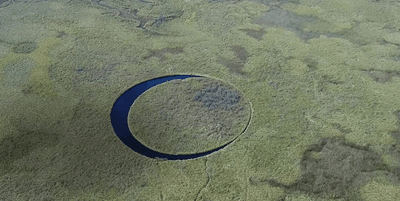


Fly over Buenos Aires to the northwest, venture through the “middle of nowhere”, and you might be lucky enough to come across a giant “eyeball” slowly glancing around the green wilderness.
This strange sight is actually a floating forest island that stirs around in a surprisingly circular lake. It’s known as El Ojo, Spanish for “the eye”, located in the Paraná Delta north of the Argentinian capital.
Measuring approximately 118 meters (387 feet) in diameter, the island is an intertwined mat of plantlife, roots, and organic matter, just buoyant enough to float on the water’s surface.
El Ojo is remarkable because it isn’t anchored to the riverbed. It drifts freely within a circular body of water, slowly rotating over time. The lake’s perfect roundness is the result of erosion: as the floating island grinds against the edges of the surrounding water, it gradually carves out a symmetrical, ring-like basin. It's a similar phenomenon to the natural formation of spinning ice disks that occasionally appear in frozen rivers and lakes.
In 2016, Argentinian filmmaker Sergio Neuspiller set out to document the mysterious floating island. From above, the formation appeared almost too precise to be natural, prompting him to investigate further on foot.
“It was a completely unexplored area. We reached it with great difficulty, after walking four hours under the Sun. I had a terrible migraine – probably sunstroke,” Neuspiller told El Observador at the time.
When he finally arrived, the sight was as strange as it was striking. “The water looked black but it was actually completely transparent. That’s almost impossible to find in the delta. The bottom was black earth,” he recalled.
North of Argentina, in the central Brazilian Amazon, there are many similar instances of “floating forest”, known as matupás. As per a 2015 study in PLOS One, local legend says the floating islands are tightly connected to the legendary cobra grande or “Giant Anaconda”, a common character in Amazonian folklore. Many people believe the mythical snake lives among the matupás, while others believe they helped to create them.
The paper notes that very little scientific literature has been published about the floating islands. Nevertheless, local Indigenous communities have detailed knowledge about their composition, dynamics, and ecological function.
The study concludes by emphasizing the value of traditional knowledge in deepening our understanding of these remarkable floating islands, which have largely eluded the attention of scientists.