Nature
 PUBLISHED


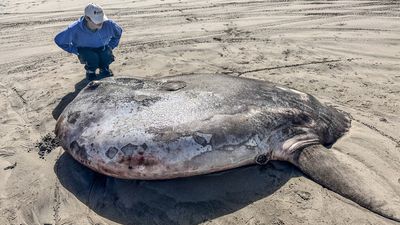


It’s all been popping off on the Oregon coastline as of late. Last week was no different, as a massive sunfish thought only to live in the Southern Hemisphere washed ashore in the north of the Beaver State.
According to a Facebook post from the local Seaside Aquarium, the 7.3-foot (2.2-meter) fish was spotted on June 3 on the beach in Gearhart. As to be expected when a giant of the ocean appears on a quiet beach on a random Monday, word quickly got around on social media and visitors flocked to the site.

Upon seeing photos of the fish, Nyegaard suspected that it was a closely related, but different species called the hoodwinker sunfish (Mola tecta).
This species was discovered by Nyegaard and a team of fellow researchers only relatively recently, only examined in person for the first time back in 2014. Despite being what you might think as noticeably big, it was the first time in 130 years a new species had been added to the Mola genus.
“We retraced the steps of early naturalists and taxonomists to understand how such a large fish could have evaded discovery all this time,” said Nyegaard in a statement at the time. “Overall we felt science had been repeatedly tricked by this cheeky species, which is why we named it the Hoodwinker.”
It was thought that the hoodwinker sunfish only occupied waters in the Southern Hemisphere, having previously been spotted off the coast of Australia, South Africa and southern Chile – rocking up on beach in Oregon would therefore be pretty unexpected.
But given the sneaky nature of this sunfish, it could have been hiding in plain sight further north, disguised as its ocean sunfish cousin to the untrained eye.
To confirm if this was the case in Gearhart, Nyegaard contacted the aquarium to see if they could take some samples for genetic testing. From these samples, measurements, and further photographs, the marine biologist confirmed it was indeed the hoodwinker.
As well as suggesting that the range of the giant fish might be further than previously thought – it’s also been spotted in California and even as far north as Alaska – the specimen that washed up may also be the largest ever sampled.
For those hoping to catch a glimpse of the elusive creature, the aquarium stated that the fish “will probably remain for a few more days, maybe weeks as their tough skin makes it hard for scavengers to puncture.”