Humans
 PUBLISHED


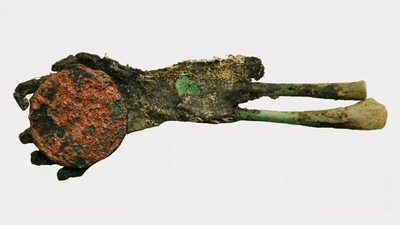


As far as archaeological discoveries go, finding a mummified hand of a tiny baby clutching at a late medieval coin is already Indiana Jones territory, if not Hellraiser. But in 2005, a team opened up a pot at an abandoned cemetery in Nyarlorinc, Hungary, and found just that. Also, the hand was green, pushing the whole find well into Indiana Jones 4 territory.
"During data collection in a Late Medieval osteological series of Nyárlőrinc-Hangár út, we have come across very small, green colored remains of a perinate individual that seemed to be partially mummified," the team wrote of the find years later.
"Preservation of these minute remains was so good that we decided to invite a specialist of other scientific fields to conduct a series of multidisciplinary investigations on the bones in order to come to a common conclusion concerning these rare findings unparalleled in the bio-archeological record."
In other strange and unexplained details of the case, a coin found alongside the remains was in circulation between 1858 and 1862. That's particularly bizarre, as the cemetery had been abandoned at least 150 years prior.
The main mystery to be explored, however, was what had caused such good preservation seen in sample, particularly of the soft tissue of the hand. And in any case, the find was pretty unusual.
"Mummified human remains are a rarity and the custom of perinate pot burials have never been documented in osteoarcheological series before," the team explained in their paper, adding: "On the basis of the bone dimensions, the age at death of the mummified pre-term individual was 6.5–7 lunar months. The body might have been approx. 28–35 cm long and weighed 0.4–0.91 kg. Our examination revealed no disease-related symptoms in the remains."
Natural mummification is rare. Though it happens through a number of methods, it usually takes place in dryer and/or colder conditions than those found at the cemetery. Furthermore, other bodies placed nearby in the cemetery decayed as normal, despite being in the same basic conditions.
Using chemical analysis on the bodies, the team found the answer: the infant's body was crammed full of copper, especially, as you'd expect, in the hand clutching at the copper coin. In fact, the copper found in the body was 497 times higher than levels found in other mummies.
The antimicrobial properties of the copper coin kept the hand, and other parts of the body that the copper had contaminated, from being broken down by microbes. The team believes it is the first solely copper-driven mummification case ever reported.
Other than measurements and a very rough time of death, the team is unsure of what exactly happened to this infant, and the remains of two other non-mummified infants found at the site.
"Even though they were definitely born older than 20 lunar months, we do not know whether they were born dead or alive, stillborn or neonate," the team wrote. "However, on the basis of what we know about the chances of survival as a preterm neonate before the twentieth century, it is very likely all three of them died a couple days the latest after their preterm birth."
Though it is difficult to say with any certainty, the team believes that the burials may be examples of families laying unbaptized stillborn babies to rest.
"Occasionally, low-value coins were put next to the body as offerings; the coins were intended to facilitate the soul’s admission to heaven or served to pay the fee on the way to the underworld or Saint John the Baptist for christening the deceased in heaven," the team explained, adding that the find would be the first example of this superstition documented in Hungary.
They concluded that with other burials taking place with copper placed near bodies, "hopefully, more cases are to appear in the future".
An earlier version of this article was published in April 2023.