Ad

space-iconSpace and Physicsspace-iconAstronomy
clock-iconPUBLISHEDMarch 26, 2026

A Giant Ribbon, Storms, And Photobombing Moons In Incredible New JWST And Hubble Images Of Saturn

Changing seasons are not an earthly exclusive.

Dr. Alfredo Carpineti headshot

Dr. Alfredo Carpineti

Alfredo has a PhD in Astrophysics and a Master's in Quantum Fields and Fundamental Forces from Imperial College London.

Space & Physics Editor

Alfredo has a PhD in Astrophysics and a Master's in Quantum Fields and Fundamental Forces from Imperial College London.View full profile

Alfredo has a PhD in Astrophysics and a Master's in Quantum Fields and Fundamental Forces from Imperial College London.

View full profile
EditedbyLaura Simmons
Laura Simmons headshot

Laura Simmons

Health & Medicine Editor

Laura holds a Master's in Experimental Neuroscience and a Bachelor's in Biology from Imperial College London. Her areas of expertise include health, medicine, psychology, and neuroscience.

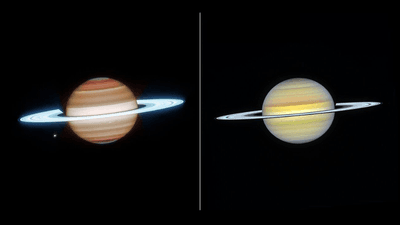
Side-by-side comparison of Saturn observed at different wavelengths and times show how differently it appears in infrared, on the left, versus visible light, on the right. Left image is labeled Saturn, Webb Infrared Light, November 29, 2024. Right image is labeled Saturn, Hubble Visible Light, August 22, 2024. In the infrared, Saturn has horizontal bands, with bands at the north and south poles appearing darker orange and lightening to tan as they approach the equator. The north and south poles glow a greenish-grey. The rings appear in an icy neon white. White dots represent several of Saturn’s moons. In visible light, Saturn’s horizontal bands appear pale yellow, with some bands towards the north and south pole having a light blue hue. The rings appear bright white, glowing slightly less than Webb’s infrared image. White dots represent several of Saturn’s moon

The JWST and Hubble side by side comparison of Saturn!

Image credit: NASA, ESA, CSA, STScI, A. Simon (NASA-GSFC), M. Wong (University of California); Image Processing: J. DePasquale (STScI); modified by IFLScience


Without a mission around Saturn like Cassini, we can’t get close-up studies of the planet anymore. That said, the Hubble Space Telescope has been keeping an eye on the Lord of the Rings for years, tracking the changing seasons on its hemispheres and the position of the rings. Now this work, combined with observations from JWST, has revealed a lot more of what's happening on the gas giant planet.

The rest of this article is behind a paywall. Please sign in or subscribe to access the full content.

Hubble and JWST see the universe in different wavelengths. JWST uses infrared, and this allows it to peer deeper into the atmosphere of Saturn. Together, these observations, which are part of a decade-long monitoring program called OPAL (Outer Planet Atmospheres Legacy), revealed a three-dimensional view of the atmosphere.

The observations were a few months apart. The Hubble ones are from August 22, 2024, and show not just the different bands in the atmosphere but also three small and very faint moons: Janus, Mimas, and Epimetheus. JWST's observations were conducted as part of the director's discretionary time and took place in November 2024. That’s a few months before the disappearance of the rings as the planet and Earth entered their periodic alignment.

From Hubble, where the color variation hints at the deeper sources of changes inside Saturn, we can jump to the JWST insights. The planet was approaching the equinox when the observations were taken. The northern summer was ending, and the Southern Hemisphere was entering spring.
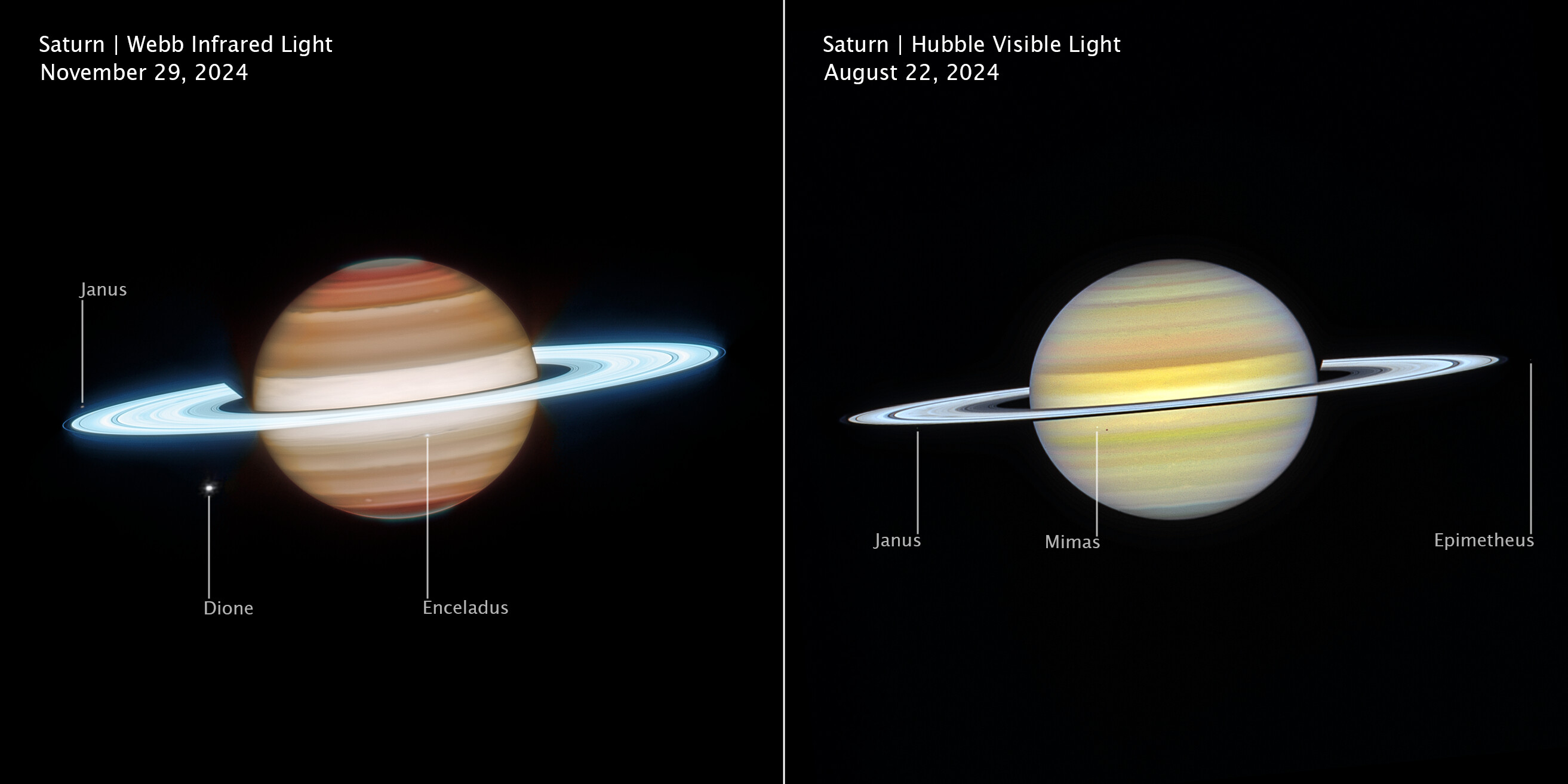
Image description: Side-by-side comparison of Saturn observed at different wavelengths and times show how differently it appears in infrared, on the left, versus visible light, on the right. Left image is labeled Saturn, Webb Infrared Light, November 29, 2024. Right image is labeled Saturn, Hubble Visible Light, August 22, 2024. In the infrared, Saturn has horizontal bands, with bands at the north and south poles appearing darker orange and lightening to tan as they approach the equator. The north and south poles glow a greenish-grey. The rings appear in an icy neon white. White dots, representing several of Saturn’s moons, are labeled Janus, Dione, and Enceladus. In visible light, Saturn’s horizontal bands appear pale yellow, with some bands towards the north and south pole having a light blue hue. The rings appear bright white, glowing slightly less than Webb’s infrared image. White dots, representing several of Saturn’s moons, are labeled Janus, Mimas, and Epimetheus
An annotated version of the comparison picture.
Image credit: NASA, ESA, CSA, STScI, A. Simon (NASA-GSFC), M. Wong (University of California); Image Processing: J. DePasquale (STScI)

In the JWST data, we see the distinct pointed edges of Saturn’s hexagonal jet stream at the north pole, a puzzlingly shaped storm that also changes colors with the season. The grey-green appearance of both poles has nothing to do with that phenomenon. It is possible that these are high-altitude aerosols or even aurorae.

The telescope also brings into focus the giant ribbon wave that meanders at mid-latitudes of the planet, and right underneath, a small spot – the last remainder of the Great Springtime Storm of 2011. For more storms, you ought to look at the Southern Hemisphere. None of them look enormous, but there are two visible at a glance, so hopefully we’ll see more activity there over the coming years as the southern part of the planet goes into summer.

JWST too sees more than just the planet, bringing different moons into focus. Janus is spotted once again, together with Dione and little Enceladus, one of the most promising places for life outside of Earth.

The telescope also allowed us to see subtleties in the rings, from the famous spokes and structure in the B ring (the thick central region of the rings) to actually showing off the thin F ring. Hopefully, this won’t be just a one-off collaboration between the telescopes to track the changing weather on the outer planets.

Add us as a Google preferred source to see more of our
trusted coverage in Search