


 Nature
 PUBLISHED


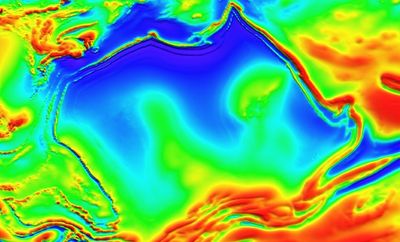


Something strange is up with Australia. And for once, it isn’t to do with their wildlife or men’s haircuts. A new geophysical survey by CSIRO has mapped a large "magnetic anomaly" under the Northern Territory with never-before-seen clarity. It suggests this part of the continent is home to unusual buried geological structures, which could illuminate the region’s formation and history. It's also coincidentally shaped like Australia, too.
The raw data was captured during the Northern Territory Government’s Bonney Well Survey. A plane, armed with a sophisticated array of sensors, flew in a "lawnmower" pattern across the region in alternating straight lines just 400 meters (roughly 1,300 feet) apart.
After feeding this high-resolution aeromagnetic data into advanced computer algorithms, the researchers created a map highlighting an unusual patch of variation in Earth's magnetic field over northern Australia.
“Magnetic data allows us to see through the ground and understand geological architecture that would otherwise remain completely hidden,” Dr Clive Foss, leader of the CSIRO research team, said in a statement. “By improving how we process and model these datasets, we can extract more geological information than ever before.”
Earth’s magnetic field is generated by the churning of molten iron and nickel in the outer core, acting as a planet-size dynamo. However, this field isn't uniform across the planet. It fluctuates based on what lies just beneath the surface, such as the presence of mineral deposits and subterranean structures.
For instance, the biggest magnetic peculiarity in the world is the Kursk Magnetic Anomaly in western Russia, caused by an abundance of iron ore buried deep beneath the ground. Another big one, the Bangui anomaly in central Africa, may have been created by a meteorite impact over 540 million years ago or a colossal intrusion of igneous rock.
The Australia Magnetic Anomaly is likely to be caused by giant geological structures hidden beneath the surface. One clue might be hiding in the outcrops of the Hatches Creek Formation. This Paleoproterozoic site consists of sandstones interspersed with volcanic layers that were rich in magnetic minerals when they formed over 1.5 billion years ago.
However, decoding these signals is easier said than done. Because Australia has drifted across the globe due to plate tectonics, and because Earth’s magnetic poles can periodically flip, it can be very tricky to unwind the history of the complex "magnetic signature" locked in these rocks.
“Estimating the depth of the anomaly’s source and deciphering the direction of magnetisation can be complicated by remanent signatures preserved since the rocks formed,” said Dr Foss.
“Australia’s shifting tectonic position, combined with periodic reversals of Earth’s magnetic field, means that remanent magnetisation often points in unexpected directions, demanding expert interpretation.”




 1
1