Nature
 PUBLISHED





Earth’s magnetic field is constantly swirling and shifting thanks to a colossal ocean of liquid metal sloshing around in its belly, but perhaps there's more to the story. In a new study, geologists argue that the planet’s metallic innards and magnetic properties might be influenced by two immense, ultra-hot rock structures located 2,900 kilometers (1,800 miles) below the surface.
Earth’s magnetic field works a bit like a dynamo. It is generated by the movement of molten iron and nickel in the outer core, which creates electric currents. However, when you follow changes in the magnetic field over millions of years, its behavior suggests something even more complex is at play.
To find out what, researchers from the University of Liverpool estimated how Earth’s magnetic field has ebbed and flowed over the past 23 million years using ancient magnetic field datasets and advanced computer simulations.
For the models to make sense, there would need to be large temperature differences in different parts of the outer core’s upper boundary. The findings also indicate that some parts of Earth’s magnetic field have remained relatively stable for hundreds of millions of years, while other regions are in a stormy state of regular upheaval.
One explanation for this might be the presence of “anomalous structures” in the uppermost core. These could be unbelievably hot, continent-sized rock structures that impact how the underlying liquid outer core behaves. Based on the simulations, it’s most likely these anomalies are located under Africa and the Pacific.
“These findings suggest that there are strong temperature contrasts in the rocky mantle just above the core and that, beneath the hotter regions, the liquid iron in the core may stagnate rather than participate in the vigorous flow seen beneath the cooler regions,” Andy Biggin, lead study author and Professor of Geomagnetism at the University of Liverpool, said in a statement.
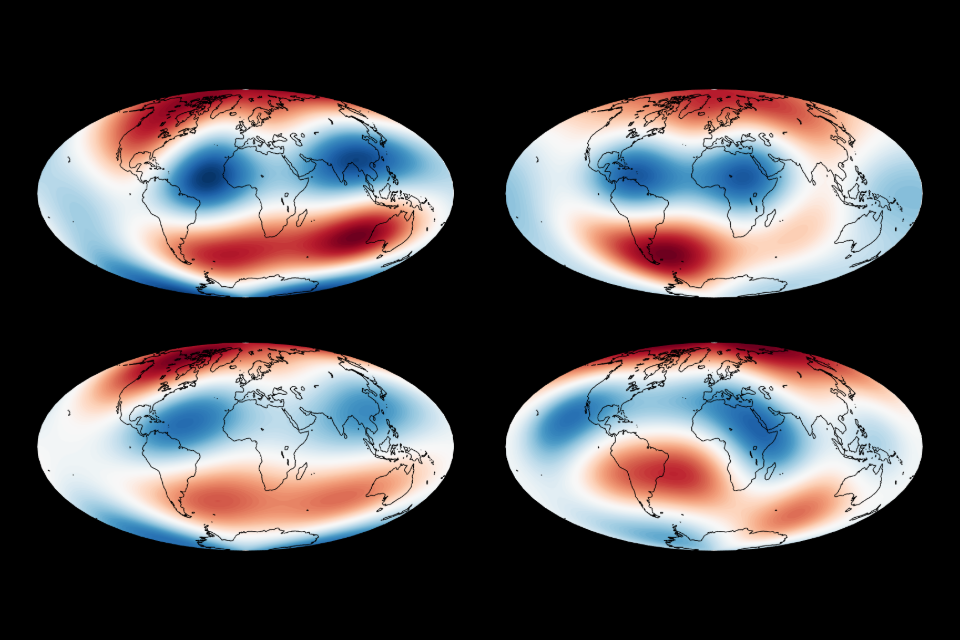
Along with influencing the magnetic field, these subterranean structures might have an impact on the layout of the planet’s continents. These influential "blobs" act as thermal anchors for the planet’s ever-moving structure. By modulating the heat rising from the core, they likely dictate the location of mantle plumes, the massive upwellings of hot rock that can eventually tear tectonic plates apart.
The anomalous structures may effectively determine where the crust remains stable and where it is destined to fracture, orchestrating the slow-motion dance of landmasses across the globe.
“These findings also have important implications for questions surrounding ancient continental configurations – such as the formation and breakup of Pangaea – and may help resolve long-standing uncertainties in ancient climate, palaeobiology, and the formation of natural resources,” said Biggin.
“These areas have assumed that Earth’s magnetic field, when averaged over long periods, behaved as a perfect bar magnet aligned with the planet’s rotational axis. Our findings are that this may not quite be true,” he explained.
The study is published in the journal Nature Geoscience.


 1
1