Nature
 PUBLISHED
 1
1


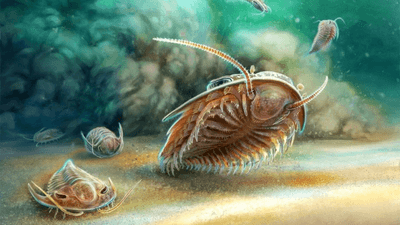


Trilobites that date back 508 million years have been found preserved in volcanic matter, revealing never-before-seen details in 3D form. Their fossilization was so rapid that tiny shells have been preserved in situ, and soft tissues including mouthparts and internal organs can still be seen.
The trilobites were entombed in pyroclastic flow, which is the hot, dense material that comes hurtling out of volcanoes sometimes reaching speeds as high as 200 meters (656 feet) per second. Typically, it burns up any life in its path, but that can change in a marine setting.
“The surface of the sea on which the ash flowed would have been lethally hot and, yes, would have incinerated animals at the shallowest depths,” study co-author Dr Greg Edgecombe of the Natural History Museum, London, told IFLScience. “The ash would have mixed with seawater as it picked up and entrained the trilobites, which were living on the sea bottom. This mixing through a column of seawater must have cooled the ash sufficiently.”
Collected in the High Atlas of Morocco, the ancient wonders have been nicknamed “Pompeii” trilobites due to their remarkable preservation in the ash. They’re incredibly old, but they aren’t the oldest trilobites ever found.
At around 508 million years old, they’re younger than the oldest trilobites, which date back to about 521 million years old. There are also older trace fossils in the form of burrows, called Rusophycus, that are thought to be the work of trilobites and exceed 528 million years in age.
However, the comparative whipper snappers are still remarkable for the degree of preservation they exhibit.
“What makes our specimens unique, and indeed especially pristine, is three-dimensional preservation of their appendages,” continued Edgecombe. “The appendages are not flattened or reoriented or broken. They were preserved in close to life orientations. And because they are preserved as void space in the rock matrix, we can image them tomographically to see them in 3D.”

“Appendages preserved in shale can beautifully preserve their setae but the fossils are compacted to the point of almost being 2D and we have to use destructive sampling to mechanically excavate upper parts of an appendage in order to see lower parts. Our specimens are as perfect after study as they were before.”
This never-before-seen detail means we are now seeing trilobites closer to real life than we have ever seen them before, complete with a slit-like mouth, and unique cephalic feeding appendages. Ain’t she a beauty?
The study is published in the journal Science.