Space and Physics



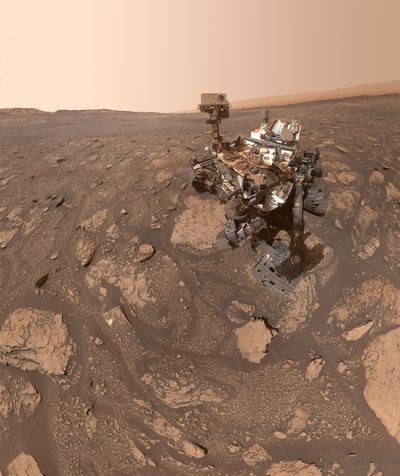


An international team of researchers reports the result of an incredible experiment performed on Mars. It had never been done before on another planet, and the experiment revealed more than 20 organic molecules that had been trapped in clay for 3.5 billion years. This has enormous implications for the search for ancient life on the Red Planet.
NASA’s Curiosity has an instrument called Sample Analysis at Mars (SAM) that can conduct nine wet chemistry experiments. Just two of them involve using tetramethylammonium hydroxide (TMAH), reserved for the highest-value specimens, so the team had to be very careful what to sample. The first TMAH experiment took place in September 2020 (Sols 2880-2882), and the result certified that the target area was an excellent choice.
"We think we're looking at organic matter that's been preserved on Mars for 3.5 billion years," lead author the University of Florida’s Amy Williams, who helped develop this chemical experiment, said in a statement.
"It's really useful to have evidence that ancient organic matter is preserved, because that is a way to assess the habitability of an environment. And if we want to search for evidence of life in the form of preserved organic carbon, this demonstrates it's possible."
Among the peculiar molecule detections, there is a nitrogen heterocycle: a ring of carbon atoms that includes nitrogen. Such a molecule has never been seen before on Mars and it is remarkably similar in structure to known DNA and RNA precursors.
“That detection is pretty profound because these structures can be chemical precursors to more complex nitrogen-bearing molecules,” Williams told NASA. “Nitrogen heterocycles have never been found before on the Martian surface or confirmed in Martian meteorites.”
The study reports many other molecules, lots of them found in meteorites, hinting at a possible source.
"The same stuff that rained down on Mars from meteorites is what rained down on Earth, and it probably provided the building blocks for life as we know it on our planet," Williams said in the statement.
TMAH is a chemical that can break apart larger organic molecules that can then be analyzed by the SAM instrument through gas chromatography. The success of this first experiment has impact for Mars and its potential habitability, but also much farther afield.
"We now know that there are big complex organics preserved in the shallow subsurface of Mars, and that holds a lot of promise for preserving large complex organics that might be diagnostic of life," Williams added.
The European Space Agency’s Rosalind Franklin rover, which will travel to Mars in a few years, is equipped with the TMAH test. The NASA mission Dragonfly, which will fly around Saturn's moon Titan, will also sport such a test.
The study is published in the journal Nature Communications.