Nature
 PUBLISHED


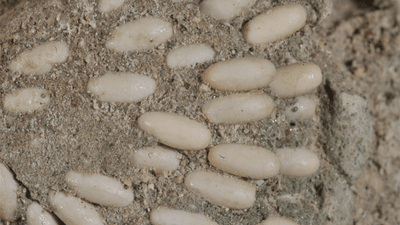


A pod of fossilized eggs has been found in John Day Fossil Beds National Monument in east-central Oregon, helping to solve a mystery of what creature had laid them (and others like them) millions of years ago.
Eggs had previously been found at the site, but only as individuals, and had been misidentified as ant eggs. After a nest filled with eggs was discovered in 2016, the eggs were identified as belonging to grasshoppers, partly due to the similarity in the shape of the eggs to modern grasshoppers, which lay them underground.
The fossil of an ootheca (a type of egg capsule produced by stick insects, cockroaches, praying mantises, grasshoppers, and other animals) was imaged using a micro-CT scanner, helping the team to get a better look at the eggs.
Different species make their oothecae in a variety of ways, creating different varieties of the egg pod. Praying mantises lay eggs into a frothy mass produced by glands in their abdomens, which then hardens, protecting the eggs.
The team found, according to the study, distinctive oothecae belonging to ancient grasshoppers "highly organized egg mass comprising a large clutch size of approximately 50 slightly curved ellipsoidal eggs arranged radially in several planes is preserved, enclosed in a disc-shaped layer of cemented and compacted soil particles".
Many grasshopper species, but not all, lay their eggs by inserting their abdomen into the soil, before making excretions that mix with the soil and then harden. The result is an ootheca that takes on the shape of the surrounding soil.
"Based on the morphology of the overall structure and the eggs, we conclude that the specimen represents a fossilized underground ootheca of the grasshoppers and locusts," the team continued, "also known as an egg pod."
The find is believed to be the oldest and most unambiguous evidence of grasshopper pods, with the fossil dating back 29 million years. Separate finds in the area indicate that populations lived stably in the region, likely supporting a range of predators in the Oligocene era.
The paper is published in Parks Stewardship Forum.