Nature
 PUBLISHED
 1
1


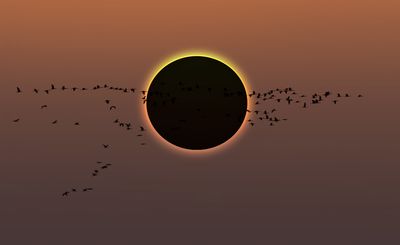


Thousands of volunteers recorded bird behavior in response to the total solar eclipse of 2024, revealing a diversity of bird responses.
For some, the wonder of total solar eclipses is enhanced with reports of animals responding as if night has come early. In 1932, New England cattle were reported heading to their barns, while frogs began to call. However, other observers dispute this, with one regular eclipse-chaser telling IFLScience, “The only animal I’ve seen responding oddly to an eclipse is humans.”
To settle this question, a team of scientists decided to collect large-scale data, with the “Great American Eclipse” of April 2024 providing the perfect opportunity. They developed and distributed SolarBird, an app to describe bird behavior during the eclipse, and were rewarded with almost 11,000 observations from 1,700 users. Most were on the path of totality from mid-Mexico to eastern Canada, but the app was also used by people as far away as California and Florida.
“Scientists can’t be in a thousand places at once,” said Indiana University PhD student Liz Aguilar in a statement. “The app gets around this problem by leveraging the public as scientists. It also encourages people to look around and listen, adding to the show in the sky.” Users were asked to find a specific bird whose behavior they could observe around totality and answer 10 checkbox questions about what it did.
The authors also established recording stations across Southern Indiana in the eclipse’s path.
Besides its length and path across some of the most populated areas of North America, the authors noted the eclipse was well-timed for bird research. “April in North America is an interesting time for birds,” they note, “many of which are preparing for their once-in-a-lifetime chance at reproduction.”
Rather than needing to rely on the participants, whose attention was understandably elsewhere, to identify the birds involved, the team created a machine learning program, BirdNET. The project allowed the team to identify the songs of 52 bird species as the sky darkened and the light returned.
The authors describe the behavior of certain species as being as if their biological clocks were reset to behave as if facing a new day.
For 23 species the eclipse was apparently just another day, but 29 showed marked changes in the sounds they produced. However, these were not all in the same direction. Ten species sang more than usual as the Sun was gradually blocked out, with only one singing significantly less. Subsequently, 19 responded to the Sun’s apparent return with songs similar to those they make before dawn.
During the period where the Sun was blocked entirely, which lasted up to four minutes in parts of the path of this relatively long eclipse, the unusual behavior was limited to 12 species, equally divided between those that sung more and less.
The strongest responses were from barred owls, who issued four times their usual calls that day, while dawn-singing robins made six times as many calls as usual during and after the peak of the eclipse.
The variation indicates that almost all previous accounts of avian responses to eclipses could be accurate – it just depended which species the observer was around. Not everything was as the authors expected, however. They anticipated birds that sing at dawn and dusk to be most affected by the eclipse, but found only those that are part of a dawn chorus were particularly likely to change their behavior in response to the eclipse.
Solar eclipses are rare enough that there’s no reason to think that species would face much evolutionary pressure to get used to them. On the other hand, this isn’t the only time animals encounter near-darkness during daylight. After all, heavy cloud, while not cutting out as much light as totality, can certainly produce effects that resemble a deep partial eclipse, and birds experience this often. Perhaps this is why another study found that during the same eclipse birds in areas where the Sun was less than 99 percent obscured barely changed their behavior.
Although the work has its romantic side, with echoes of the eclipse that had a more dramatic effect on the behavior of one bird in the film Ladyhawke, there is a disturbing message as well.
“This natural experiment underscores the power of light in structuring animal behavior: Even when “night” lasts for just 4 minutes, robust behavioral changes ensue,” the authors write. It’s not surprising then that artificial light at night is also affecting many birds’ behavior, and in much more lasting ways.
“It’s crazy that you can turn off the Sun, even briefly, and birds’ physiology is so tuned to those changes that they act like it’s morning. This has important implications on the impact of urbanization or artificial light at night, which are much more widespread,” said Dr Kimberly Rosvall.
The authors hope their work, and future eclipse observations, could help explain why some nocturnal species are more affected by artificial light than others.
The study is published open access in Science.