Space and Physics
 PUBLISHED




NASA needs you! Or, more precisely, they need your phone to help study the Sun during the coming eclipse on April 8, 2024.
Now we're sure conspiracy cranks are poised at their keyboards to claim that this is some large takeover effort, or whatever, but there is actually good reason for the initiative. NASA are encouraging people interested in the celestial event to participate in their SunSketcher program. By installing NASA’s forthcoming app, you can use your phone to gather data on the so-called Great American Eclipse 2024 to help them map the star’s shape.
As Professor Gordon Emslie, the principal investigator, explained, “The 2024 Eclipse offers an unprecedented opportunity to measure the shape of the Sun and so to infer its inner structure. The SunSketcher project will use smartphone observations by Citizen Scientists situated along the two-thousand-mile-long eclipse path from Texas to Maine to reveal the precise shape of the solar disk."
You may be wondering why we need to ascertain the shape of the Sun. I mean it’s clearly a sphere, right? Well, that’s not really true, one of the key factors being that the Sun is made of plasma, and so it's not a solid. So, when it spins, it bulges in the middle, just as any other rotating spheroid does.
This property is called oblateness, but is sometimes referred to as polar flattening. To be sure, the Sun is not the only celestial body that experiences this. Within our Solar System, Earth, Jupiter, and Saturn all exhibit oblateness to different extents.
But the Sun’s oblateness is influenced by various peculiarities associated with its interior distribution of rotation, which is not uniform. For instance, the motion of sunspots tells us that the surface rotation is “differential”, which means the spots move at different speeds depending on where they are – spots at the equator move 10 percent faster than those at higher latitudes. Scientists also expect that the flow of gas accompanying convection and magnetic activity leads to transient distortions at a smaller level as well.
This is where the SunSketcher data comes in and why NASA want your help. As they explain, the data will “allow scientists to probe details of the interior of the Sun. An accurate measurement of the solar oblateness will also allow very precise calculations of the effects of solar gravity on the motions of the inner planets (e.g., Mercury), and comparison with observations of planetary motion will thus provide a test of different gravitational theories.”
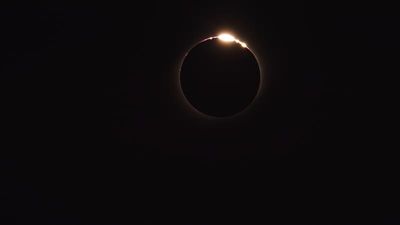
So how does this all work? Well, aside from the help of citizen scientists using the app, scientists also need to recruit the Moon for assistance. When the Moon makes its final move across the Sun during a total or annular solar eclipse, there’s a spectacular moment when small flashes of light can be seen. This phenomenon is known as Baily’s beads and occurs when the Sun’s light moves across the moon’s uneven surface (its craters, hills, and valleys).
“This phenomenon has very precise parameters”, NASA explain. “[T]he geometry of the observer-Moon-Sun coincidence, and its exact time on sub-second timing scales. The parameters differ systematically for observers located at different places and times within the path of totality.”
This is where SunSketcher app comes in. It is programmed to take a series of photographs of the Baily’s Beads as they occur at the times of second and third contacts. Depending on where you are within the path of totality, the flashes will occur at different times. NASA can use this data to better map the Sun’s oblateness.
“With your help, we hope to create a massive hour-long database of observations, more than we could ever make on our own,” NASA explained.
You can already download the SunSketcher app for iPhone, and the Android version is coming soon.