Space and Physics
 PUBLISHED




The Transiting Exoplanet Survey Satellite (TESS) continues to be a revolutionary planet hunter. The NASA mission has found many thousands of planet candidates by spotting them as they crossed their own stars. Researchers now report the discovery of a new planet with a method for which TESS was not designed.
TESS uses the transit method. When a planet passes in front of its stars, it dims the starlight by a small fraction. If this dimming repeats at regular intervals, you have a likely planet. Microlensing is also a planet-spotting method, which uses the fact that stars and planets warp spacetime with their gravity.
If a star passes in front of another more distant star, it will get a bump in brightness due to the magnification of the faraway object. If the foreground object has a planet, this microlensing effect would have a second bump.
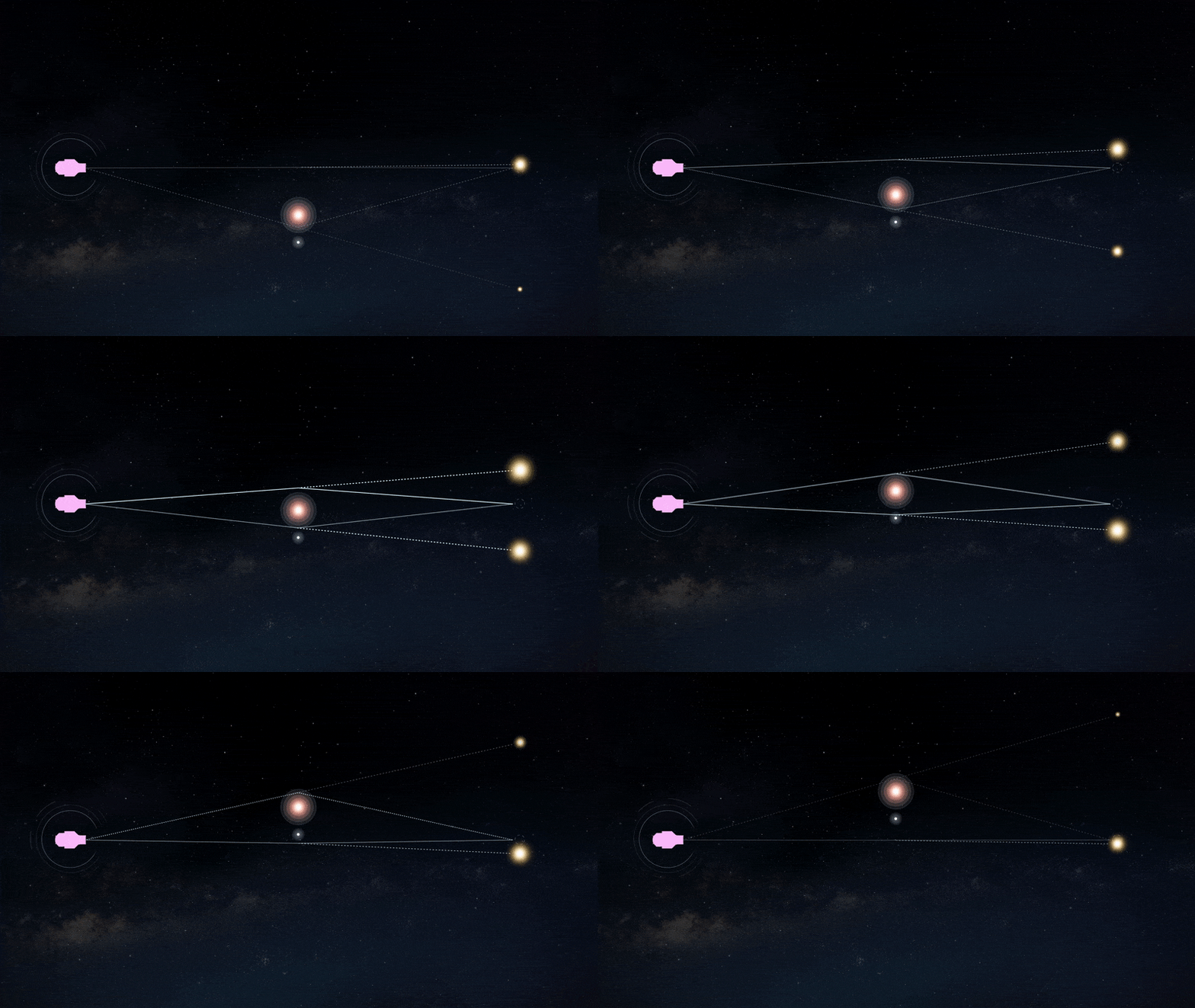
“TESS has been observing the sky for nearly eight years and has repeatedly monitored regions along the Galactic Plane, where this system is located,” lead author Mallory Harris, a graduate researcher at the University of New Mexico, said in a statement. “Despite this extensive coverage, Gaia23bra b represents the first definitive microlensing planet discovered using TESS data.”
“When TESS launched, no one expected it to ever be capable of finding this kind of planet,” said University of New Mexico Professor Diana Dragomir. “The discovery implies that there are probably other microlensing planets hiding in TESS’s data that we hadn’t previously thought to look for.”
The first hint that a microlensing event had taken place came from ESA’s Gaia observatory. The now-retired telescope spotted Gaia23bra b event, alerting astronomers of the possible planet. Unfortunately Gaia’s data in the instance was not good enough, but fortunately TESS also had an eye on the same area.
“Gaia’s observations were too sparse to pick up on the planet. TESS happened to be monitoring the same area of the sky during the event, and its denser time coverage showed extra features in the light curve caused by a planet,” Harris continued.
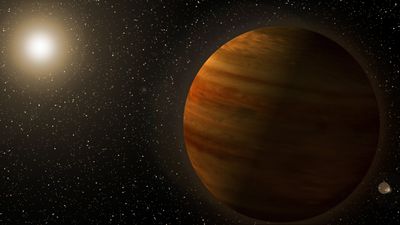
Thanks to TESS, the team was able to estimate that the planet is 1.63 times as massive as Jupiter, and orbits an orange star 80 percent of the Sun’s mass at roughly the same distance as Jupiter’s orbit around the Sun.
Microlensing is possible only with serendipitous alignment but gives you access to different types of planets.
“The main advantage of microlensing lies in the kinds of planets it is sensitive to. Planets that orbit very close to their host stars effectively blend with the star’s mass and do not produce a distinct microlensing signal. With microlensing, we can find smaller planets with greater orbital distances, including worlds in the habitable zone of their star and even farther away,” Harris explained.
“Transits and microlensing are very complementary because they each reveal a category of planet the other may not be able to detect,” Dragomir said. “And they offer different details. Transits give us the size of a planet, and in concert with other methods we can determine its mass and density. Microlensing gives us masses and orbital distances for planets we’d otherwise never see.”
It is certainly possible that more lensing events are hiding within the extensive TESS catalog, waiting to be found.
The study is published in The Astrophysical Journal Letters.