Nature
 PUBLISHED
 9
9



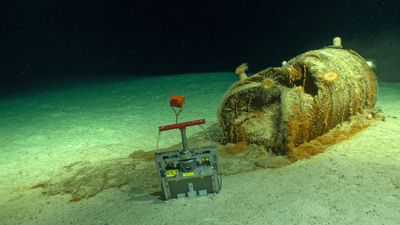


We humans are great at making things, but historically we’ve not been very good at finding sensible ways to get rid of them. Case in point: 200,000 barrels of radioactive waste dumped in the Atlantic Ocean between 1950 and 1990.
Past mistakes
We used to think that deep-sea disposal was a fine idea for ditching low-level radioactive waste because - the theory went - it would sit in the barrels long enough to lose its potency. However, by 1975 the potential harms raised enough concern that the London Convention was brought into force to protect the marine environment.
This convention limited radioactive dumping until eventually it was ruled out altogether. The only problem was by then we’d already been doing it for decades.
To keep track of the impact this caused, scientists have been returning to the site in the north-east Atlantic to monitor the barrels and the surrounding environment. In May of this year, the Nodssum project, led by the French National Centre for Scientific Research, set off to investigate if and how the barrels are affecting deep-sea ecosystems.
Around 30 scientists were on board the Pourquoi Pas?, and helped complete 20 crewed dives on board Nautile (part of the French Oceanographic Fleet) to depths of over 4,700 meters (15,420 feet).
Their findings weren’t good, but they also weren’t terrible.
Bye bye, barrels
The barrels are now in an advanced state of deterioration. So much so that several of them have already leaked their contents into the surrounding water.
This was, to be fair, always a part of the early “let’s dump our radioactive waste in the ocean” plan. But that doesn’t mean it was ever a good idea.
But the good news is that the measurements taken on site indicate that the overall levels of radioactivity actually remain low, although they're still higher than what would normally be expected. Essentially, the contamination is there, but it doesn’t yet constitute a major event.
The low levels meant the teams were able to handle the samples without requiring much in the way of radiation protection. They’ll now be taken back to the lab along with samples of water, sediments, and living organisms to further study how the radiation is interacting with the environment and its inhabitants.
Photos show some animals are now growing on the barrels. A reminder that wildlife has no concept of trash when finding a new home.
Lost and found
It’s a regrettable reminder that while we might only have observed less than 0.001 percent of the ocean, we’re certainly making our mark on it. Dives all over the ocean have revealed surprise findings, such as the search for a shipwreck that *checks notes* turned out to be a bunch of washing machines, and the strange halos forming around barrels of chemicals dumped off the coast of LA.
We might not be able to get all our rubbish back, but in studying what happens next we can hope to better inform future – and more sustainable – ways of discarding of the things we make.