Nature
 PUBLISHED


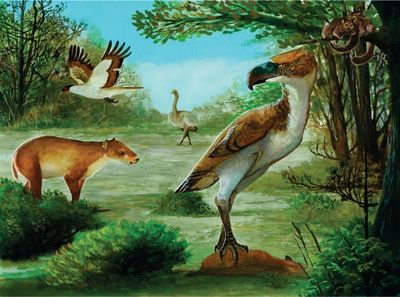


You’d be forgiven for the terms “flightless birds” and “Antarctica” conjuring up images of happy little penguins waddling about on the ice. But with new research in hand, let us take you back 50 million years ago to discover a much scarier creature lurking on the then-warmer continent: terror birds.
Dr Carolina Acosta Hospitaleche and her team were digging through La Meseta Formation – a deposit of sediment from the Eocene on Seymour Island, Antarctica – when the researcher came across something unusual.
“Large continental predators were missing in the Antarctic assemblages. We only knew a diurnal raptor among birds, and small insectivorous marsupials. We never found a large carnivore, until now,” Dr Acosta Hospitaleche explained to Palaeontologia Electronica.
Rather than the plethora of small mammal fossils often found on the island, the researcher had uncovered two 8-centimeter-long (3-inch) fossilized claws, suspecting that they belonged to a large, flightless animal known as a terror bird.
This title is normally given to birds in the extinct family Phorusrhacidae, whose members are often considered to have been fast and active carnivores. Whilst the claws found in Antarctica indicate they could belong to this group, the age of the fossils and lack of other parts of the skeleton means Acosta Hospitaleche and fellow study author Dr Washington Jones can’t firmly put the find in this category. However, they do think it likely belongs to this or a closely related group.
Regardless of its scientific label, it’s likely the claws formed only part of a formidable creature. The researchers estimate that the terror bird would have been about 2 meters (6.5 feet) tall and weighed about 100 kilograms (220 pounds), putting it firmly in the heavyweight class.
As for which unfortunate creatures met their untimely end at the hands of these birds, it’s suggested that the birds primarily snacked on small and medium sized vertebrates, like marsupials and ungulates (a group that today includes pigs and deer). Their large claws and sharp, hooked beaks would’ve helped in bringing down such prey.
According to the researchers, this suggests that the birds “fulfilled the role of continental apex predators”, a finding which they believe “unequivocally reshape[s] our understanding of the dynamic of early Eocene Antarctic continental ecosystems.”
It’s hoped that there will be further fossil finds that reveal more details about these terror birds and the environment in which they lived millions of years ago – and erosion might help researchers along the way.
“The Antarctic islands undergo significant erosion, unveiling new fossils annually. The continuous exposure of fossils due to erosion presents a unique opportunity for us to uncover more about the ancient ecosystems of Antarctica,” concluded Acosta Hospitaleche.
The study is published in the journal Palaeontologia Electronica.