


 Space and Physics
 PUBLISHED



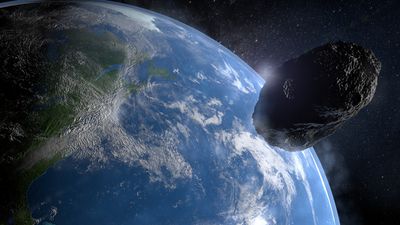


Looking for Near-Earth objects (NEOs) has demonstrated a simple fact: there are a lot of rocks in space, and many of them come very close to Earth. We have tracked the orbit of all the biggest NEOs, but the smallest ones reflect so little light that our telescopes can only snap when they are close. It is not surprising, then, to see tens of tiny asteroids being discovered only when they are about to pass by Earth.
Amateur astronomer Tony Dunn must have been particularly impressed by the November crop of new asteroids to have put the 18 space rocks that passed Earth within the orbit of the Moon into a wonderful orbital graphic – each one discovered just that month.
The graphic shows a very sped-up view of the movement of the Solar System, and thanks to the observations stretching for three weeks, it looks like a swarm of asteroids is coming towards Earth, before spreading out again. It's also fun to see which asteroid passed with little deviation, and which has been deflected significantly, such as 2025 WV13. This space rock, perhaps as large as a house, was about 24,000 kilometers (15,000 miles) from Earth.
None of these asteroids is particularly large; the largest had a range between 12 and 28 meters (40 to 92 feet). If one of them were to fall to Earth, they would likely burn up in the atmosphere in a bright and powerful bolide like the Chelyabinsk one, which caused extensive damage but no fatalities as it fell over Russia in February 2013.
As Dunn points out, all these objects were spotted just days before their closest passage to Earth. Less than a dozen asteroids have ever been discovered before they impacted Earth, and all just a few hours before, so even a few days can mean safety for many people if such an object were to fall on a populous area. To stress the unpredictability of these detections, Dunn has 18 asteroids in his animation, but three more asteroids flew within the orbit of the Moon in November after he posted the video – and he posted it on November 29!
However, 21 asteroids is not a record-breaking month. October had 30 objects flying closer than the Moon to Earth. Within the last year, there have been 191 objects detected, so October was a more anomalous month than November. Still, the simulation shows that near-Earth objects are being discovered, and hopefully, before they can end up doing some real damage.


 1
1