Humans
 PUBLISHED


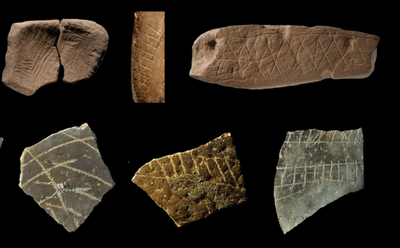


Long before humans invented complex systems of symbolic communication, they began experimenting with abstract forms by engraving designs on rock surfaces and animal bones. The meaning and purpose of these prehistoric markings remains poorly understood and fiercely debated by researchers, yet a new study may help to settle the argument by revealing the most likely function of our earliest etchings.
Researchers sought to understand the motivations behind engravings made roughly 100,000 years ago on artifacts discovered in Blombos Cave and the Diepkloof Rock Shelter, both of which are in South Africa. To learn about the cognitive processes behind these markings, the team recruited 108 volunteers to take part in an archaeological experiment.
Participants were divided into 12 different “chains”, each containing nine “generations”. The first person in each chain was shown a picture of one of the ancient engravings and asked to copy it as accurately as possible.
Like a kind of visual telephone game, this drawing was then passed on to the next person in the chain, who produced their own copy before handing this on to the next participant, until the designs had undergone nine rounds of iterative reproductions. This enabled the researchers to observe how drawings evolve when they are passed down from generation to generation.
In all 12 chains, the designs became more regular and symmetrical as they progressed through the generations. According to the researchers, this may reflect an inherent aspect of human cognition, whereby our in-built tendency towards order and structure influences the evolution of our drawings.
Things got even more interesting, however, when the experiment was repeated under three different conditions of cultural transmission. In the first of these, participants were instructed to make their drawings decorative, with no additional meaning or purpose.
The second condition, meanwhile, required participants to attempt to transmit their cultural identity through their designs, so that those viewing the markings could guess which of the 12 chains a particular artist belonged to.
Finally, the third condition involved the transmission of information, whereby volunteers had to try and communicate a particular concept - such as “fire”, “cloud”, “fish”, or “eye” - through their drawings.
Under all three conditions, drawings became “increasingly salient, stylistically distinct, perceived as intentional, and memorable,” explain the study authors.
Crucially, though, those produced under the decorative and group identity conditions couldn’t be distinguished from one another, while those made for communicative purposes could - probably because participants adapted their designs to try and convey the required concept.
Comparing these designs to the original prehistoric markings, the researchers found that those that were drawn for decoration or as group identity markers remained consistent with the 100,000-year-old engravings, while those that attempted to communicate did not.
“The cognitive profile of the original engravings lacks the signature of denotational communication, which constitute robust experimental evidence against a proto-script interpretation, and rather strongly support aesthetic and group identity-marking functions,” write the study authors.
They therefore conclude that the markings from Blombos and Diepkloof were intended to be decorative or as symbols of group identity, but were not an early form of written communication.
Looking more closely at the evolution of the drawings as they moved down the 12 chains, the researchers found that certain cultural premises automatically produced corresponding changes in form. For example, as symbols became more salient, they unintentionally also became more noticeable. Likewise, as the designs evolved to become easier to remember, they simultaneously began to appear more intentional.
In other words, as humans began to deliberately incorporate certain design features, other useful properties emerged as side effects. According to the study authors, this shows that the cultural evolution of prehistoric engravings may have occurred automatically as drawings were passed down and reproduced through the generations, rather than as a result of any sudden genetic mutation that altered our cognition.
“The cognitive capacities for symbolic thought is therefore not simply a biological precondition of culture; it is, in a meaningful sense, one of culture's products,” write the researchers.
The study is published in the journal Evolution and Human Behavior.


 1
1