Space and Physics
 PUBLISHED
 1
1



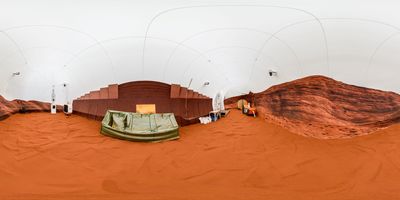


Long-term exploration of the Solar System requires knowing what being there will be like. The best way to do that is by running experiments that inform us of the challenges. This is why NASA is running CHAPEA (Crew Health and Performance Exploration Analog), sending four simul-astronauts on a year-long mission where they will have to deal with what it would be like to be on Mars. Their time is almost up and NASA will be streaming their reemergence live this weekend.
Dr Kelly Haston, Ross Brockwell, Dr Nathan Jones, and Dr Anca Selariu have been in a 3D-printed Martian habitat inside the Johnson Space Center since June 25, 2023. The habitat is 158 square meters (1,700 square feet) and contains what is expected in a future Martian base. It might not be as disorientating as those long cave experiments, but we think the astronauts will be happy to be free.

Over the last year, the team went on simulated spacewalks, performed robotic operations, kept up the habitat, exercised, and even grew crops. The experiment was to be realistic and amp up the hardship so communications with the outside world happen with at least a 20-minute delay.
How to watch
The crew has just over a day left and will leave the habitat at 5 pm EDT on Saturday, July 6. NASA will stream the crew's exit back to "Earth" featuring a short welcome ceremony on NASA+, NASA Television, the NASA app, the agency’s website, and NASA's Johnson Space Center's X and Facebook accounts.