Nature
 PUBLISHED


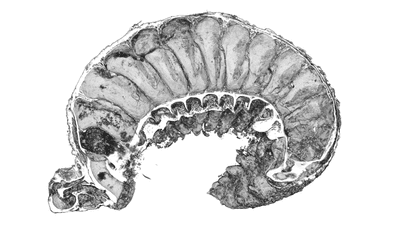


A worm larva dating back half a billion years has got a group of scientists very excited, and with good reason. Sitting right at the beginning of the arthropods, its body may contain insights into the evolution of a vast range of animal groups, including insects, arachnids, crabs, and centipedes.
The fossil has been named Youti yuanshi, taken from the Pinyin yòutǐ, meaning larva, and yuánshǐ, which means primitive. It’s a hat tip to the young age of the animal when it was preserved, locked for the rest of time in an early developmental stage, and the significance it holds in revealing the origins of the euarthropod body plan.
Youti dates back 520 million years, landing it in the Cambrian Explosion, which was a bumper bonanza of species diversification. It was at this time that the key animal groups we see on Earth today first emerged, including the arthropods.
This group of invertebrates is characterized by hard exoskeletons and versatile body plans, and they include things like arachnids, crustaceans, and insects. They’re among the most successful animals on the planet due to their adaptability to the environment, but they don’t always preserve so well in the fossil record.

“Hold my beer,” said one poppy-seed-sized worm from the Yu’anshan Formation in Yunnan Province, China, because it was found in an almost perfect state of preservation. Using synchrotron X-ray tomography, a team of scientists were able to create 3D images of the fossil, revealing preserved brain regions, digestive glands, a primitive circulatory system, and remnants of nerves.
Suffice to say, they were pretty amazed by what they saw.
“When I used to daydream about the one fossil I’d most like to discover, I’d always be thinking of an arthropod larva, because developmental data are just so central to understanding their evolution,” said lead researcher, Dr Martin Smith of Durham University in a statement.
“But larvae are so tiny and fragile, the chances of finding one fossilised are practically zero – or so I thought! I already knew that this simple worm-like fossil was something special, but when I saw the amazing structures preserved under its skin, my jaw just dropped – how could these intricate features have avoided decay and still be here to see half a billion years later?”
The team hope further investigation of their remarkable miniature find could yield insights into the steps evolution had to take to get us from this poppy seed to the incredible diversity of arthropods we see alive today. That includes the development of specialized antennae, mouthparts, and eyes that have enabled them to be so successful.
Not bad, for a wee worm.
The study is published in Nature.


 1
1