Nature
 PUBLISHED
 2
2


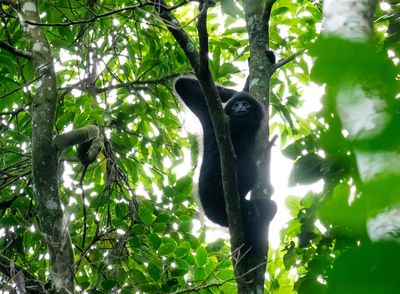


Footage of the world’s second rarest primate, the cao-vit gibbon (Nomascus nasutus) has been recorded in a forest in Vietnam.
Two adults and one younger gibbon can be observed playing together in the leafy canopy before the infant tumbles through the trees. The species exhibits sexual dimorphism where the males are black and the females have a brown or yellow coat.

Cao-vit gibbons, also known as eastern black-crested gibbons, are thought to only number around 135 individuals in the wild and are classed as critically endangered by the IUCN. They were presumed extinct until 2002 when the remaining population was rediscovered by scientists in a tiny patch of forest on the border with China.
The name “cao-vit” comes from the call of the gibbon – they defend their territory by singing and are one of four rare species of gibbon found in Vietnam according to Fauna & Flora International. The gibbons have become so reduced in numbers because of the threats of habitat loss and degradation because of livestock grazing and the destruction of the forest for firewood.
The world’s rarest primate is also a gibbon species: Hainan gibbons number just 28 individuals in a rainforest in Bawangling National Nature Reserve, in western Hainan. “The Hainan gibbon [Nomascus hainanus],” said Samuel Turvey, a senior research fellow at the Zoological Society of London in a statement in National Geographic “is the world’s rarest ape, the world’s rarest primate and, almost certainly, the world’s rarest mammal.”
Fauna & Flora have worked hard to slowly increase the population of cao-vits, protecting the remaining individuals from these threats and working with officials in both countries. In 2012, governments in both Vietnam and China signed an agreement to help conserve the habitat for this threatened primate.