Nature
 PUBLISHED
 9
9


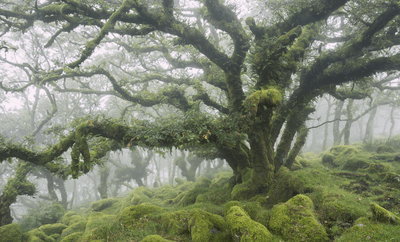


With its eerily twisted oaks and moody mist, Wistman’s Wood feels like a fantastical landscape salvaged from a forgotten time – and in many ways, it is. This ethereal woodland is one of the UK’s final remaining fragments of temperate rainforest.
Wistman’s Wood sits high on Dartmoor in Devon, an upland in southwest England, just within reach of Atlantic weather systems that sweep moisture inland. Located 380 to 410 meters (roughly 1,250 to 1,350 feet) above sea level, cool air and high humidity create the conditions needed to incubate this rare and fragile ecosystem.
Temperate rainforests, sometimes called Atlantic or Celtic rainforests, flourish in places where wet conditions and mild temperatures converge. They tend to take root in steep valleys or at higher elevations near the coast, where dampness lingers, creating a perpetually dank and cool environment.
This unique blend of conditions gives rise to a mist-laden biome where green mosses and lichens cloak every tree and rock, forming a living tapestry that supports rare birds and elusive mammals.
Wistman's Wood is dominated by pedunculate oak, though ash and beech trees are also plentiful, alongside smaller numbers of rowan, hazel, and holly. A fundamental part of this ecosystem is its mosses and lichens, including the exceptionally rare horsehair lichen (Bryoria smithii), which occurs at only two sites in Britain. Many of these lichens grow very slowly and can live for decades, if not centuries.
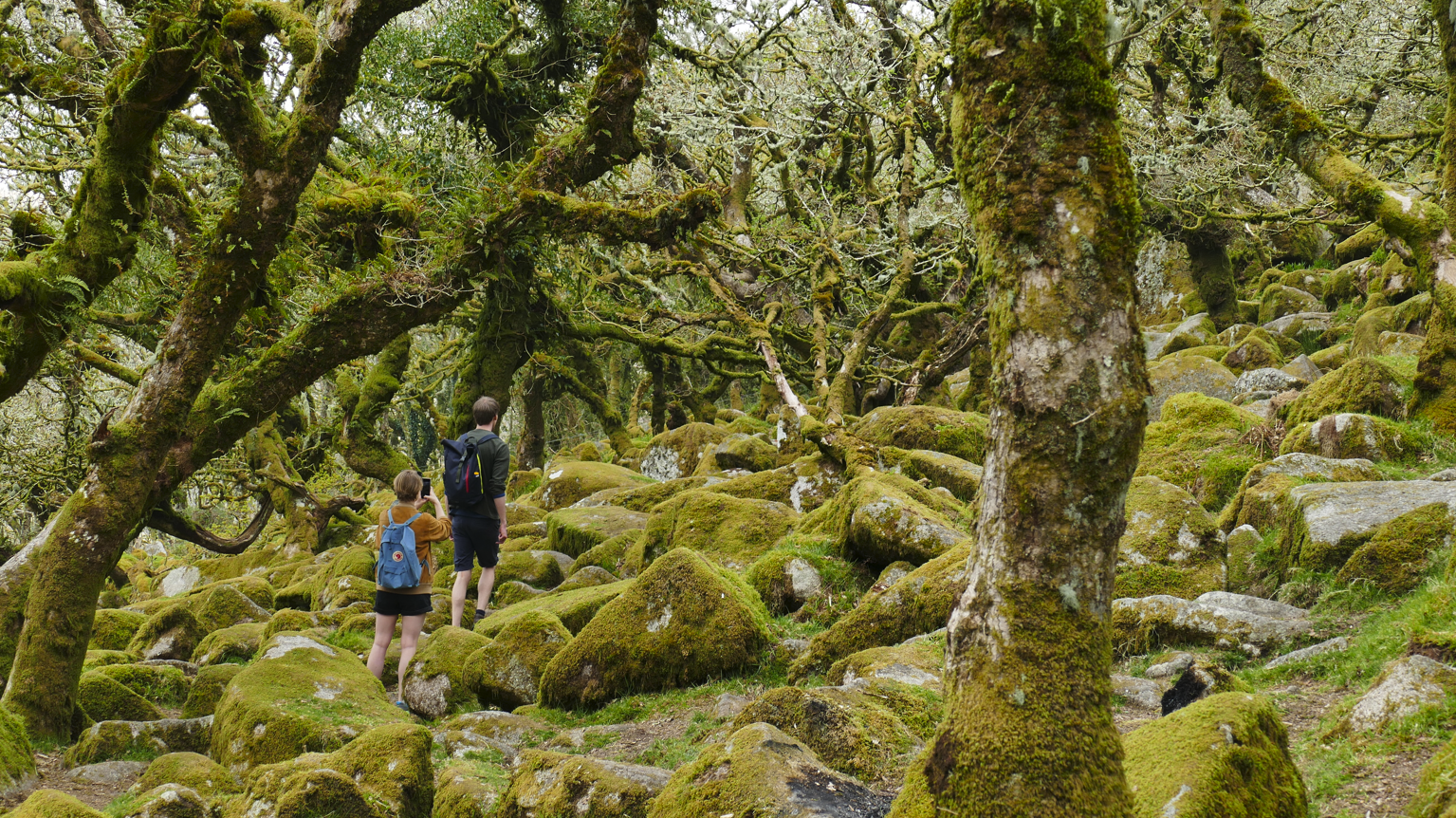
Legend has it that Wistman’s Wood was a favourite haunt of the Druids, and the forest remains steeped in tales of ghosts and other supernatural spirits. It has even been suggested that it inspired J. R. R. Tolkien’s Fangorn Forest and the Ents. Although this has never been confirmed, it's easy to see where the tale came from.
While much of prehistoric Britain was once covered in lush temperate rainforest, centuries of farming and land clearance have steadily decimated these ecosystems. By some estimates, more than 90 percent of temperate rainforest has vanished since the Bronze Age. It’s thought that Wistman’s Wood only survived the onslaught because of its high elevation and surrounding valleys, which put off farmers and herders.
In Britain today, less than 1 percent of land is classified as temperate rainforests. These dwindling environments are limited to just a handful of isolated pockets, largely confined to the western seaboard near the Atlantic coast, including the West coast of Scotland, North and West Wales, Devon, Cornwall, Cumbria, and parts of Northern Ireland.
It’s a similarly bleak outlook in other countries that are home to temperate rainforests, including the US, Canada, Chile, Japan, Australia, and New Zealand.
Unfortunately, Wistman’s Wood has become a victim of its own beauty. An endless stream of articles, books, TV shows, and social media posts about the site has driven an influx of tourists in recent years. The situation became especially fraught during COVID-19 lockdowns, when droves of people attempted to stave off "cabin fever" by visiting the outdoor beauty spot.
“Up to 400 people are visiting it every day. I don’t want to discourage people from coming and enjoying Dartmoor but many people coming to Wistman’s Wood are not interested in conservation,” Philip Sanders, Devon county councillor, reportedly said in 2021.
“Until recently, only local people really knew about it, but with coronavirus restrictions this year people have been coming from further afield. Moss and lichen are being taken, which is illegal… This takes hundreds of years to grow. The route to Wistman’s Wood is a footpath, not a bridleway, yet people have been taking mountain bikes down there. The damage is irreparable,” he added.
Earth’s changing climate is another threat these troubled environments don’t need. With rising temperatures, the delicate balance of temperate rainforests is being disrupted. A 2024 study found that climate could drive up to 68 percent of the world’s temperate rainforest, and in some regions 90 percent, into extinction over the next few decades.
People are pushing back against these disruptive forces, though. In March 2025, the Duchy of Cornwall announced a project to regenerate and expand Wistman’s Wood, planting 450 young trees and setting aside a newly fenced area to protect them. The ambition is to double the size of the wood, creating a living “mirror” of the ancient ecosystem.