Humans
 PUBLISHED


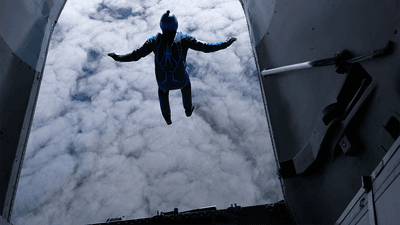


On October 14, 2012, Austrian skydiver Felix Baumgartner broke several records and the sound barrier as he leapt out of a capsule 38,969 meters (127,852 feet) above the ground, the highest skydive ever attempted to date.
That jump, meticulously planned by the Red Bull Stratos project, was a long one. From the moment he leapt from his capsule to the moment he touched the reassuring ground, a whopping 9 minutes and 9 seconds had elapsed. It wasn't all plain sailing, either.
"The exit was perfect but then I started spinning slowly. I thought I'd just spin a few times and that would be that, but then I started to speed up," Baumgartner explained to Guinness World Records. "It was really brutal at times. I thought for a few seconds that I'd lose consciousness. I didn't feel a sonic boom because I was so busy just trying to stabilize myself."
Harrowing as that may sound to someone whose idea of fun doesn't involve screaming towards the Earth at terminal velocity, compared to the ordeal of Lieutenant Colonel William Rankin, Baumgartner's jump was like hopping off a tall chair.
On July 26, 1959, Rankin – a veteran of World War II and the Korean War – was flying an F-8 Crusader jet from South Weymouth, Massachusetts, to Beaufort, South Carolina, when his aircraft hit trouble. Up ahead were some huge storm clouds, and he decided to climb to around 14,300 meters (47,000 feet) as a precaution.
At that height, his engines failed, and Rankin realized he was going to have to eject from his aircraft, and fall all that distance back to Earth, right through a cumulonimbus cloud.
"Also called the King of Clouds, cumulonimbus clouds span the entire troposphere, known for their towering height and icy, anvil-shaped tops," the UK Met Office explains. "Cumulonimbus clouds are menacing looking multi-level clouds, extending high into the sky in towers or plumes. More commonly known as thunderclouds, cumulonimbus is the only cloud type that can produce hail, thunder and lightning."
Temperatures in the cloud would be around -50°C (-58°F), which is pretty cold, but not your number one priority when there isn't enough oxygen to breathe during your fall. But like it or not, Rankin was out of options.
"Power failure. May have to eject," he told his wingman, per Time, before adding to himself quite accurately, "This is going to be a pretty high one."
Rankin pulled at his ejection lever, losing a glove in the process before shooting out of the now doomed aircraft. Outside of his pressurized cabin, he was immediately met with the consequences of decompression, and his nose, mouth, and eyes began to bleed.
"I had a terrible feeling like my abdomen was bloated twice its size. My nose seemed to explode. For 30 seconds I thought the decompression had me," Rankin explained to Time. "It was a shocking cold all over. My ankles and wrists began to burn as though somebody had put Dry Ice on my skin. My left hand went numb. I had lost that glove when I went out."
Rankin knew that if he were to pull the cord and release his parachute, he would suffocate or freeze to death within the cloud. Instead he relied on the parachute automatically opening at around 3,000 meters (10,000 feet). These systems open the parachute when an inbuilt barometer reaches a certain atmospheric pressure, indicating that the skydiver is this height from the ground.
For what felt like an eternity, Rankin was thrown around by the rising air, whilst lightning cracked around him. Eventually his parachute did open, but to Rankin's dismay it was clear that he was still far above 3,000 meters, given that he remained within the cloud itself. Now those updrafts had a giant parachute to work with, and Rankin began to rise and fall over and over again, through the cold and the ice, and with a dwindling emergency oxygen supply to keep him going. According to Rankin, he could be blown up and down as much as 1,800 meters (6,000 feet) at a time.
Eventually, Rankin did manage to descend through the cloud, avoiding lightning and suffocation as he did so. At that point he thought that he was home safe and free as long as he could make the landing. He did so, but unfortunately it wasn't an ideal landing, as his head collided with a tree before he fell down through the branches. Checking his watch, he realized that he had been falling for a total of 40 minutes.
Rankin sought help, finding a road and flagging down a car to help get him medical attention. In hospital he was found to be in surprisingly good condition, suffering only from a little frostbite and decompression sickness. Whilst not exactly a fun time, it's probably the best outcome you can expect after falling through a storm cloud for over half an hour. Rankin survived his ordeal, and went on to live until 2009, dying at the age of 88, on the outside of a cloud.