Space and Physics
 PUBLISHED



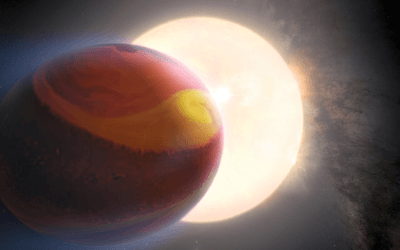


WASP-121 b is an extreme planet. It orbits so close to its star that it's shaped more like an egg than a sphere and is so hot that iron and maybe even liquid sapphires and rubies might be falling on its night side. The proximity to stars has helped astronomers look at this distant world and, thanks to observations across several years, they have captured its extreme, changing weather patterns.
Weather forecasting is difficult on Earth, let alone on a planet located 880 light-years from us. The planet is heated to a few thousand degrees on its day side and it goes around its star every 30 hours or so. The team used data from four different observations, reprocessing it for consistency, having a view of the planet at different moments around the star, showing marked differences.
“Our dataset represents a significant amount of observing time for a single planet and is currently the only consistent set of such repeated observations. The information that we extracted from those observations was used to characterise (infer the chemistry, temperature, and clouds) of the atmosphere of WASP-121 b at different times. This provided us with an exquisite picture of the planet, changing in time,” lead author Quentin Changeat, a European Space Agency (ESA) Research Fellow at the Space Telescope Science Institute, said in a statement.
From that exquisite data, the team employed a modeling simulation to understand what was happening to the temperature of WASP-121 b. The algorithm showed that the data could be explained by massive cyclones being created and then destroyed due to the massive temperature difference between the two fixed faces of the planet: the one always pointing at the star and the one pointing away from it.
“The high resolution of our exoplanet atmosphere simulations allows us to accurately model the weather on ultra-hot planets like WASP-121 b,” explained Jack Skinner, a postdoctoral fellow at the California Institute of Technology and co-leader of this study. “Here we make a significant step forward by combining observational constraints with atmosphere simulations to understand the time-varying weather on these planets.”

“Weather on Earth is responsible for many aspects of our life, and in fact, the long-term stability of Earth’s climate and its weather is likely the reason why life could emerge in the first place,” added Changeat. “Studying exoplanets’ weather is vital to understanding the complexity of exoplanet atmospheres, especially in our search for exoplanets with habitable conditions.”
The study is accepted for publication in The Astrophysical Journal Supplements and available on arXiv.