Nature
 PUBLISHED


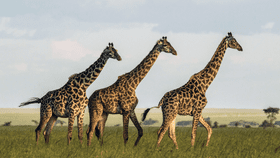


New research published in the journal Proceedings of the Royal Society B has found that, like the Beatles sang, friends really do help you get by – if you’re a giraffe. The heartwarming discovery was made by a research team led by Monica Bond, a research associate at the University of Zurich (UZH), who were studying the social lives of giraffes in Tanzania.
The five-year project aimed to investigate the influence of social circles, human activity, and the environment on the survival rate of one of Earth’s most iconic herbivores. They looked at animals in the Tarangire region of Tanzania, an area that contains multiple social groups that range from 60 to 90 female giraffes. Female social groups are the most stable, as males will leave family groups when they mature and then bounce around between groups, spending more time alone compared to females.
The researchers carried out network analyses and combined this data with survival rates to understand which animals were surviving longer in which groups, and what factors could be influencing this. They found that giraffe group formations aren’t set in stone, and will change even within the course of a day. Females are more likely to form long-term friendships, however, and the social lives of these individuals have an impact on their survival rate.
"Grouping with more females, called gregariousness, is correlated with better survival of female giraffes, even as group membership is frequently changing," said Bond in a statement. "This aspect of giraffe sociability is even more important than attributes of their non-social environment such as vegetation and nearness to human settlements."

Poaching aside, the biggest threats for female adult giraffes include malnutrition, disease, and stress, which all overlap with one another. When females were with their buddies, they were likely to be more efficient foragers, as they can share information about where the best grub’s at. Having some backup also helps when dealing with predators and illness, and even acts as a shield from unwanted advances from male giraffes.
“Studies increasingly show that social connectedness plays a key role in determining survival, in addition to natural and anthropogenic environmental factors,” wrote the study authors. “For adult female giraffes, grouping with more other females, even as group membership frequently changes, is correlated with better survival, and this sociability appears to be more important than several attributes of their non-social environment.”


 1
1