Culture and Society
 PUBLISHED


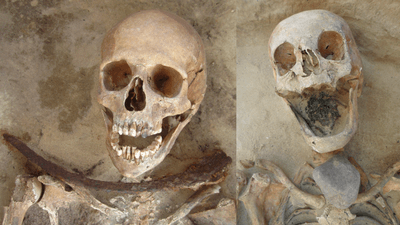


Many horror stories take inspiration from Eastern Europe, where tales of vampires once shaped how we interred the dead. Here, skeletons dating back to the Middle Ages have been found with rocks on their throats, nails through their spines, and sickles around their necks – all given after death.
The goal? To stop them getting up again, this time as vampires.
Back then in Eastern Europe it was thought that the body and the soul were distinct entities, and after death the soul could drift around without its anchor for 40 days. Most souls were innocent, but a small minority were feared to be at risk of returning as vampires.
Certain factors were thought to increase the likelihood of a person’s body later taking on this malevolent form, and the people of the Middle Ages weren’t taking any chances.
We see examples of this at Drawsko, a rural settlement in northwestern Poland that has been occupied since the Medieval period. It’s home to a cemetery site found on its eastern edge known as Drawsko 1, which dates back to the 17th and 18th centuries.
It’s been studied since 1929, but more rigorous investigation didn’t begin until the late 2000s, details of which feature in a 2014 study published in PLOS One. Between 2008 and 2012, 285 human skeletons were found – six of which were deemed “deviant”, meaning there was something unusual about the way the person was interred.
At Drawsko 1, that includes a sickle around the neck, a rock on the throat, and a nail through the spine. All of these have a shared goal: to prevent whomever it was who died from getting up again.
These are not considered normal elements of a burial from this era and instead suggest the dead were suspected of being at risk of coming back as vampires. They range in age and sex, and the sickle was the most popular shackle of choice, with five having one either around the neck or abdomen that were “intended to remove the head or open the gut should they attempt to rise from the grave.”
Two individuals had large rocks beneath their chins that are interpreted as a means to prevent them from biting or feeding on the living. For rather extreme measures, it seems a little odd, then, that these graves weren’t separated from the rest of the cemetery.
So, what was it about these people that had locals so concerned they might return from the dead? Some have suggested they may have been distrusted as outsiders, or due to some kind of disease.
The remains at Drawsko would appear to fly in the face of this, however, possessing isotopes in their dental enamel that suggest they were from the area. Their skeletons also don’t reveal any markers of disease, stress, or trauma.
It’s possible that a disease such as cholera (that doesn’t tend to leave a mark on the skeleton) could be to blame, and the researchers state that typically the first person to die from an infectious disease outbreak was considered to be at greater risk of returning. Alternatively, something about their personal identity may have raised suspicion among the community.
Many questions remain as to whom such practices were reserved for. But these burials can provide a remarkable snapshot to the past in reflecting how a person was viewed in life based on how they were treated in death.
People might not believe in vampires anymore, but they sure left their mark on our past.